An archaeologist visits Bodyworlds

Recently, I was lucky enough to have an opportunity to visit the incredible Bodyworlds exhibit in Amsterdam, The Netherlands. I have seen and handled plastinated specimens before in a university department, but I had not seen them on display in a museum context. In this blog post, I will discuss some of the thoughts I had as an archaeologist concerned with the ethics of human remains display, and how these modern-day collections echo some of the sentiment applied to collections of the past. The technology involved in creating these plastinates is simply amazing, and if you have any interest in human anatomy I would highly recommend visiting the exhibit.


The Bodyworlds exhibit: Where and what?

The exhibit I visited featured 200 plastinated human specimens on public display. This particular exhibit was entitled The Happiness Project. The exhibit had over 200 plastinates on display – if you want to read more about the process of plastination then you can do so here. Plastination involves preserving real human bodies using a process that removes water and fat. These are replaced with plastics, making the specimen dry and stopping the decaying process. Von Hagens invented the process and has exhibited the Bodyworlds plastinates to millions all over the world. The Happiness project used the plastinates to show how our happiness is impacted, and how our health is related to our mood. One of the infographics outlined the sources of happiness in one’s life – suggested that 50% was genetics, 40% was what we could control, and 10% was sources outside our control.


Gender assignment without consent
There was a group of four of us that attended the exhibit. On one of the levels we entered we were greeted by a large screen that we could not avoid. The screen assigned us a gender and an age category automatically. I couldn’t help but recognise how uncomfortable this may have made some people, especially those who may be struggling with their gender identity, or who identify as non-binary. You are assigned male or female, with some people at the exhibit being mis gendered by the screen. Also, many people were pointing out they were also given a different age bracket – most were being given an older age then they actually were. Not great in a society that dwells heavily on anti-aging. I could see that some visitors were a bit uncomfortable with this element of the exhibit, and I couldn’t understand why this element was incorporated. The screen reading itself was showing how ‘happy’ the viewer was by reading their face – but I think the gender/ age element was unnecessary. The body and identity – particularly gender identity – is a topic under discussion in both archaeological and contemporary contexts. Control of one’s narrative is important and having one’s identity ‘up on screen’ without their input is quite intense.


The identifiable nature of the human head
One of the human heads on display still maintained their facial features, it did not look like the classic image of a plastinate – the ones which look unidentifiable with the muscles depicted. This head still has hair and the outer layer of skin attached. The face was quite identifiable – if a family member had seen it they would definitely have recognised them. Obviously, the donor in this case gave their body to be plastinated – fully consenting. However, I still wonder if the donor and their loved one realised this would have been the case if they were viewing the more ‘classic’ plastinates. Although the head was anonymised – meaning they were not named etc. – it still was a jarring sight. Nevertheless, the head is an amazing feat of preservation technology which shows the realistic element of a cadaver – a stark contrast to skeletal remains and historical fluid preserved specimens on display in museums. The ‘flesh on the bones’ really humanises the plastinate, I could even see moles and other spots on the skin.

The sex plastinate
If you have read about the Bodyworlds exhibit, you have probably heard about the sex plastinate that caused controversy some time back. The controversial plastinate in question showed two cadavers preserved in the reverse cowgirl position. With articles with headlines such as ‘You Can See Dead People Having Sex for Less Than $20’ appearing on the internet it’s clear the pose certainly ruffled some feathers. The Happiness project also has a sex plastinate on display, which showed two cadavers in a much less provocative pose, but still showing sexual intercourse regardless. I thought this display was presented fantastically – It wasn’t shocking, but was presented beautifully, somewhat unexpected in a city often associated with sex. And why shouldn’t sex be presented? It is, after all, a huge element of life. Sex and death have strong links in many ways – both are taboo but also get people interested and talking. In fact, I thought another plastinate perched on a swing with their legs opened slightly was a little more provocative to the viewer.


Art versus human remains
Overall, I highly recommend the Happiness Project if you are visiting Amsterdam. The technology involved in plastination is incredible and these donated bodies are presented fantastically – skilfully linking art and science. Not often are the general public able to view anatomical specimens, and Bodyworlds gives the layperson that opportunity through exploration of wellbeing. As an archaeologist visiting the exhibit I couldn’t help but compare these remains with archaeological and historical displayed specimens – and I kept having to tell myself that these people consented. No matter how different these displays are to other museums displays – one has to remember plastination is voluntary, unlike excavated and historically preserved remains in many cases. On that point alone, Bodyworlds is commendable.

Death on Display: The Dead in the National Museum of Ireland: Archaeology

Five Examples of the Displayed Dead

In March 2022, I visited the National Museum of Ireland on Kildare Street, Dublin. This archaeology museum is free to the public and is well worth a visit if you are ever in Dublin. The human remains are displayed very well in the museum, being securely laid out behind glass and lit very well. The bog bodies exhibit in particular is laid out excellently. I remember visiting this museum as part of my undergraduate modules when I was studying at UCD. Here are five examples of how the dead are displayed in the museum.

Clonycavan Man, Co Meath.

Date: c. 392-201 BC

The bog bodies on display in the museum are perhaps the most evocative of the dead featured. The display of the bog bodies is done in a respectful manner, with visitors able to bypass viewing the remains if they wish. Clonycavan Man is featured in the Kinship and Sacrifice Exhibit, which also features the other Irish bog bodies. Clonycavan Man was found in 2003 and is believed to be a murder victim, with possible indications that he was mutilated as part of a ritual killing (his nipples are missing for example). He also seems to have suffered a deep head wound that may have been the cause of his death. A reconstruction of the face of Clonycavan Man further humanises him – a ‘face put to the name’, as well as the discussion surrounding his ‘gel’ hairstyle which consists of resin. The hair and skin of Clonycavan Man is visible, although they have changed to a brown colour due to the anaerobic conditions of the bog, but his features are still very visible regardless. I highly recommend visiting this exhibit if you are ever in Dublin – they are a fantastic resource to engage in conversations about death and the display of the human body.

Replica of Clonycavan man
Clonycavan man

Viking Burial, Memorial Park, Co Dublin.

Date: c. 9th Century

An almost fully intact skeleton is on display in the Viking Ireland section of the museum. The skeleton dates to the 9th Century as was found in 1934 at Memorial Park, Island bridge, Dublin. The burial is labelled as belonging to a warrior, as a dagger and sword were found with the skeleton. Unfortunately, there does not seem to be much other information accompanying the burial, which may have been due to a lack of information being gathered and recorded at the time of discovery. Furthermore, members of the public are not told whether the burial is male or female, something not known to the untrained eye – it is simply implied by the ‘warrior burial’ label. The ‘warrior burial’ label was also critiqued by Howard Williams on his blog (link in sources section).  The skeleton is dimly lit with partial reconstruction done on some elements of the skeleton. The glass case makes sure the remains are secure and cannot be touched by members of the public, and the darkness of the exhibit does allow one to appreciate the fact human remains are on display. Should these skeletal remains be presented in the same manner as the bog bodies? I.e., in a small, labelled section away from public view? These are the questions one should ask as a viewer – how much of human remains is too much for the public?

Viking burial

Burial 24, Mound of the Hostages, Hill of Tara, Co Meath.

Date: c. 2000 BC

Burial 24 contained an inverted encrusted urn and an inverted vase – the urn contained the remains of at least one adult, and a burnt flint knife was also found with the remains. As there is work going on in the museum at the moment, the entrance is now through the Hill of Tara section where this burial is located. You almost pass it by as you enter the museum. The exhibit shows fantastic finds through the centuries at the Hill of Tara. What is interesting about the cremated remains is that one would likely not realise you were viewing human remains unless you read the label on the exhibit. Do people pass by these remains without realising they are passing a part of someone? It would be interesting to do observations of visitor interactions with all the exhibits containing human remains and see how different ‘types’ are reacted to.

Cremated remains seen in the centre

Human Skull, John’s Lane, Co Dublin.

Date: c. 10th Century

As part of the Clontarf 1014: Brian Boru and the Battle for Dublin exhibit at the museum, I will be focusing on the human skull found at John’s Lane, Dublin. The skull itself is place in a glass case with an accompanying label stating the skull is from a young man, and that a large wound to the side of his head may have been fatal. What is unsettling about the skull, is the fact it is placed as though found with a ‘slave chain’ that was recovered from a completely different context. It gives the impression that this individual was from the slave trade, despite not being found with the chains – I remember mentioned the issues with this display as a case study as part of my undergraduate visit. It may be that the placement of the chain is to provoke a reaction from the viewer. The chain was found in Roscommon and may have been made for a slave or hostage.  Although the placement is obviously to illustrate what it would have been like for someone to wear such a device, it does make one feel slightly uncomfortable knowing the man displayed with the chain was not a wearer in life. A question of identity and post-mortem bodily integrity comes to mind.

The skull and chain display

Ptolemaic Mummy, Provenance unknown (Egypt).

Date: c. 300 BC

There is a large number of objects from Ancient Egypt at the museum, with the Egyptian collection found in the upper galleries. Most of the items on display were acquired from excavations carried out between the 1890s and 1920s. There are a few mummies on display, but for this blog post I will focus on the Ptolemaic Mummy of unknown provenance which dates to c. 300 BC. Unlike the Leeds City Museum, there is no sign outside the exhibit warning people that human remains are on display. This may be because unlike the mummies in Dublin, the Leeds mummy is unwrapped (He was unwrapped by the surgeon TP Teale in the 1820’s), and his facial features are on display and very prominent to the viewer. The mummies in Dublin are still wrapped – providing a ‘layer’ between them and the viewer. The unknown provenance of the mummy is likely due to the retention of the remains outside of Egypt from a dig over 100 years ago – post excavation records were likely not as detailed, particularly during a time when colonial attitudes were rife. The mummy in question is displayed very well with as much information as possible attached to the exhibit – they are also well lit in an area that has dimmed overhead lighting. A great way to show respects but also highlight to artefacts of importance.

One of the mummies on display

Sources

https://100objects.ie/slave-chain/

https://news.leeds.gov.uk/news/leeds-museums-and-galleries-object-of-the-week-coffin-of-nesyamun

https://www.museum.ie/en-IE/Museums/Archaeology/Exhibitions/Kingship-and-Sacrifice

https://www.museum.ie/en-IE/Museums/Archaeology/Exhibitions/Rites-of-Passage-at-Tara

Public interactions with human remains: Sedlec Ossuary

I had the privilege of visiting Sedlec Ossuary in the Czech Republic a few weeks ago. The ossuary is in Kutna Hora and is known as the ‘bone chapel’ or the ‘chapel of bones.’ Between 40,000 and 70,000 individuals are thought to be on display – all the remains are skeletal. The ossuary has a long history that stretches back as far as the 13th century. An abbot scattered soil from the Holy Land on the site and it became a desirable place to be buried in the region. Thousands of people were buried there before they were moved to a crypt after the cemetery became too full. Many of the deceased were victims of the Black Death or were killed during the Hussite Wars. It was around the 16th century that exhumation of the bones begun.

It wasn’t until the 19th century that the so-called macabre art was created from the remains. A local woodcarver called Rint arranged the bones in an artistic manner in 1870, before signing the wall with the bones themselves. Rint bleached the bones and created the famous bone chandelier, a coat of arms, candle holders and large bone pyramids. The resulting artwork attracts hundreds of thousands of visitors a year, and even in the short time I was there in the off season I could not help but observe the different reactions to the remains.

I was travelling with a group of archaeologists, who are all well acquainted with skeletal remains but still understand the respect that needs to be shown towards these displays. Upon entering the ossuary, we were told not to take any pictures. This is a recent rule that had to be enforced in January 2020 as many who visited the site were asked to take photos in a respectful manner and did not comply. A press release from the ossuary stated that many were taking derogatory photos, inappropriate selfies and were touching/ manipulating the remains for a picture. Now, you must apply for permission to take photos in the ossuary at least 3 days in advance of your visit with reasons outlining your intentions regarding the distribution of the media.* I was intrigued to see if everyone followed the rules as we entered the chapel.

The reactions to the remains were polarising, even though there was only a small number of visitors at the time we went. One young couple were taking pictures pretty much straight away, with the young woman posing with her hand placed on the bones of the candle holders whilst her partner snapped the image. They were not reprimanded by any staff members as there was not many working there on the day we were there, but it was shocking to see a blatant disregard for the rules straight away. Touching of the bones is forbidden and outlined on the ossuary website. The bones were used as a prop in a picture, exactly how was described in the press realise.

One woman started laughing loudly at the site as she turned to leave, stating ‘this is not for me!’ Another rule outlined on the website is to keep the noise down to show respect for the dead. It was likely this woman was very uncomfortable and didn’t know how to react to the remains. I heard the rest of her group say outside that they weren’t ‘expecting whatever that was!’ and that they expected the bones ‘to have been ground up and used as cement rather than displayed’ (both comments have been edited for clarity). Obviously, the group were not keen on the visit, and did not research the site properly before visiting.

As an archaeologist who studies the dead, it was hard not to cringe at some of the reactions of others at the site, but we must understand that not everyone will grasp the fact that these disarticulated remains were once people and are not objects. The fact that the remains have been arranged in such a manner may make it difficult for those who do not often come in contact with the deceased not to see them as objects, or perhaps become extremely uncomfortable with display. However, we must encourage those who intend to visit the site to research it before hand and become acquainted with the rules – something which evidently didn’t happen on the day we visited. The defleshed body can often leave us far removed from the deceased, as skeletal remains are not something we see every day, but we should always treat them with respect – whether they are arranged in a manner you do not agree with or not.

If you are interested in human remains and studies of death, then I would definitely recommend a visit to the ossuary. You can find the list of regulations in the resource list below – just remember the ‘chandelier’ or ‘candle holders’ were/ are human and should be treated as such.

(*Images used in this blog post were taken by an archaeologist before the ban on photography was introduced.)

Sources

https://www.atlasobscura.com/places/sedlec-ossuary

https://www.sedlec.info/pro-media/

https://en.wikipedia.org/wiki/Sedlec_Ossuary

The Archaeology of Assassination: Grief, Gore, and Glorification.

In this blog post I will look at three examples of assassination and the material that has been left behind from them. These objects and archaeological sites are poignant reminders of the grief the loved ones of those targeted felt upon their death, as well as the intense fear of those present when these assassinations occurred. These objects are emotionally charged, with some containing the biological material of the assassinated. Often these types of archaeological artifacts are controversial regrading their display, but they seem capture the public interest in museum settings. These examples are just some of the famous archaeological materials, sites, or ‘relics’ left behind from some of the history’s most famous assassinations. 

  1. Abraham Lincoln (1864)- Objects: The Derringer pistol of John Wilkes Booth and the lead bullet from Lincoln’s autopsy.

John Wilkes Booth entered the theatre box of Lincoln and his wife on the 14th of April 1865. This was a mere 5 days after General Lee had surrendered to General Grant, bringing an end to the American Civil War. Booth shot Lincoln once in the head using a 5.87-inch tiny derringer pistol. The tiny ‘pocket pistol’ was only armed with one shot, and the lead ball fired from the gun entered below Lincolns left ear before it was retrieved during his autopsy at the White House by Dr Edward Curtis. The bullet is on display at the National Museum of Health and Medicine in Maryland, with the pistol itself on display at Ford’s Theatre. In 1940, the War department allowed the weapon to be displayed along with other relics associated with the assassination. 

Interestingly, there is a poll on Ford Theatre’s website asking whether the murder weapon should be on display, and if so, how should it be displayed? Four presidents have been assassinated in the US (all with guns), with two of the firearms used on display whilst two are not. The Buffalo history museum currently displays the pistol used to assassinate William McKinley in 1901. Are these weapons a gruesome oddity, or are they important artifacts associated with death that should be put on display? Are they glorifying the assassins who pulled the trigger, or are the glorifying the ones who were shot by these weapons? We may never know the answer to these questions, and whilst these artifacts are undoubtedly significant historical archaeological artifacts, the loved ones left behind and their grief should always be considered in the display of such trauma related objects – in the case of Lincoln, over 100 years has passed since his death, meaning immediate loved ones have died also.

The pistol used by John Wilkes Booth (Source: loc.gov)
The bullet that killed Lincoln (Source: history.com)

2. John F. Kennedy (1963)- Object: The blood-stained dress of Jackie Kennedy.

The assassination of President John F. Kennedy at the hands of Harvey Lee Oswald is perhaps the most famous assassination of all time. Kennedy was shot in the head on the 22nd of November 1963 as he rode in a motorcade in Dallas, Texas. Bullets struck both his head and neck, and he slumped onto his wife who held his head as they sped to the hospital a few minutes away. Nothing could be done to save JFK, and he was pronounced dead less than an hour after the motorcade had commenced in Dallas. One of the most iconic images surrounding the assassination is Jackie in her blood-stained pink Chanel suit. Jackie kept the blood-stained suit on hours after her husband’s death. She was seen wearing it as she accompanied her husband’s body to Air Force One and as she stood beside Lyndon B. Johnson as he took the oath of office. Jackie was sending a clear message, stating ‘I want them to see what they have done’ – the first lady wanted the world to know what had happened to her husband. The pink suit became iconic, an outward display of glamour as well as grief. So where is the suit now?

The pink suit was brought to the National Archives for safe keeping, and Caroline Kennedy agreed in 2003 that the suit could go on display once 100 years had passed. The suit is kept in a controlled environment for preservation and will be shown to the public in 2103. What a fascinating piece of archaeology this suit is and will become, with the bloody remains of one of the most famous men of all time splattered across the garment. The suit is shown in the iconic photographs of a formidable, grieving widow. The suit will serve as a reminder of the distress Jackie must have felt having been seated next to her husband and sprayed with his blood upon the impact of the bullet that killed him. Jackie suffered from post-traumatic stress disorder after the incident, suffering from nightmares, suicidal thoughts and drinking problems in the time that followed. That pink Chanel suit is both a physical and emotional reminder of traumatic death and dying as well as the strength of one woman, showing that even the most powerful in the world are not immune to such tragedies.  

Jackie Kennedy in her blood stained Chanel suit (Source: lessonslearnedinlife.com)

3. Julius Caesar (44BC)- Place: Curia of Pompey.

Caesar was stabbed to death by Roman Senators at the Curia of Pompey (built in 55BC) – a meeting place at Pompey’s Theatre. Led by Brutus and Longinus, Caesar was stabbed 23 times by the senators after tensions rose when Caesar was named dictator perpetuo. He was stabbed on the 15th of March – infamously known as ‘the Ides of March’ in 44BC. In 2012, the Spanish National Research Council (CSIC) claimed to have found the spot where the assassination took place. In Largo di Torre Argentina square, Rome, a 3m wide structure was found by archaeologists. Augustus (Caesars’ adopted son) is known to have built a structure matching the description of the concrete building described by researchers – allowing excavators to confirm the significance of the site. The site was a cat sanctuary before researchers began to carry out excavations of the complex – and continues to house cat colonies today. At present, the ruins can only be observed at the street level above.

In 2022, the area the Curia of Pompey is located, known as the Area Sacra, is to open to the public as an open-air museum. Restorations will begin in the area, where the ruins of other Republican era temples are located, with the aim of opening after the Covid-19 pandemic to attract tourism. Is it wrong to use the site as a tourist attraction, knowing that this is where one of the most infamous assassinations took place? Is this an element of dark tourism? These are questions that many will consider as the structure becomes accessible to the public, but there are many other archaeological sites that ‘showcase’ assassination or public execution. Such sites may include gallows or beheading sites that can be found in many historical places across the UK. What the Curia of Pompey does is highlight and humanise the death of a world leader who has become more than a mere man in the two thousand years since his murder. Perhaps the archaeology associated with his assassination will allow the public to think more about his death, and the bereavement of his family and allies that followed.

Area Sacra where the Curia of Pompey is located (Source: Lonely Planet)

Sources

The Victorians as Dark Tourists: Mortality, Morbidity, and the Macabre.

Dark tourism is an umbrella terms that usually refers to sites, archaeology, museums, and other aspects of heritage linked to the themes surrounding death, tragedy, and destruction. It is quite difficult to define what exactly counts as dark tourism, but usually it counts places such as medical museums, graveyards, disaster sites such as Chernobyl, or murder trails (Jack the Ripper comes to mind). According to Psychology Today, the reasons people visit these sites vary. A ‘dark tourist’ may feel drawn to a site/attraction as they may be feeling curious, empathetic, nostalgic, or perhaps they have an interest in horror or simply want to educate themselves. Whatever the reason, dark tourism is on the rise in recent years (I would probably describe myself as a dark tourist)- but when we think of a past population fascinated with the macabre, who do we think of? The Victorians are usually top of the list.

Whether you think the Victorians had a morbid fascination with death and the macabre, or whether you think they were simply realistic about their own mortality, it cannot be denied the Victorians DID death to an extreme by modern, western standards. Mourning and the dead played a large role in everyday life, with much influence stemming from Queen Victoria’s 40-year mourning period of her husband Prince Albert. In this blog post, I will highlight some examples that can be used to call Victorians the ultimate ‘dark tourists’. Even though death played an important role in their everyday, personal lives (with extended mourning periods the norm and showy funerary monuments sought after), it can be said the Victorians sought out the macabre as a means of entertainment as well. These are just a few examples I have highlighted- there are many more I simply cannot fit into a blogpost.

Medical Museums

One of the most famous examples of the Victorian medical museum is that of Dr Joseph Kahn’s. In the first half of the 19th C there was a growing interest in anatomy amongst the public for a couple of reasons. One was the case of the infamous murderers Burke and Hare in the 1820s, and the other was the incorporation of waxworks to display anatomical structures. Kahn opened his anatomical and pathology museum on Oxford Street in the 1850s, and consisted of specimens preserved in fluids, as well as wax models. Initially the museum was highly praised by the Lancet, but there was some distaste shown concerning the sections showing venereal disease and embryology. Ladies were admitted separately and were not allowed to view some specimens. The museum collection toured around Britain, with separate sections only allowed entry by ‘medical men’. The tour was extremely successful amongst the Victorian population but failed to turn over a lot of financial prophet. Kahn’s downfall came with his involvement in quackery, particularly surrounded his selling of venereal disease cures on site. The medical profession began an anti-quackery campaign against Kahn, and many suggested he should have been prosecuted under the Obscene Publications Act of 1857 (the Kahn Museum under the Jordan’s was prosecuted in 1873). Eventually the museum closed and was broken up, but there are surviving accounts from the general public on visiting the museum. Many members of the population described their visits as a harmless day out, and it is thought that many likely learned the facts of life there as well as other anatomical aspects of the body. ‘Medical dark tourism’ is a category defined in dark tourism and describes visits to medical museums with human specimens amongst other medical related sites. It is clear many Victorians fell within this category in the same manner many do today.    

Medical Museum of Dr Kahn

The Morgue

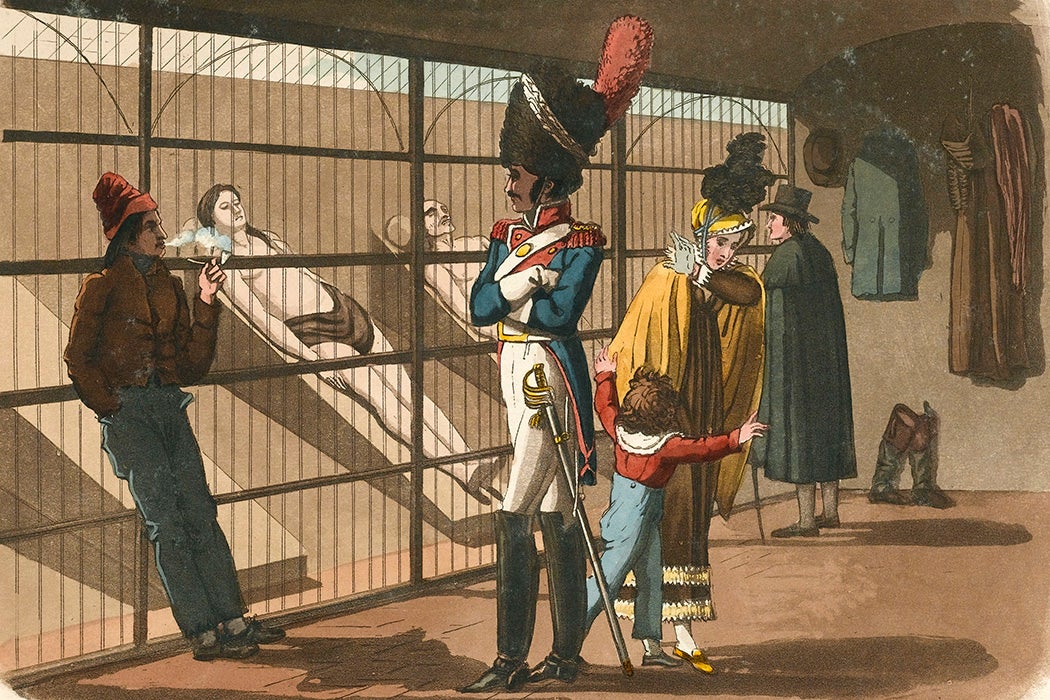
When one thinks of death as spectacle in the 19th century- the Paris Morgue stands out. The Morgue became one of the most popular tourist attractions in Paris by the late 19th century – around 40,000 people are thought to have visited a day at its height. Public access initially allowed members of the public to view unidentified dead to see if they were a missing family member. However, most viewers simply went to the morgue as a means to view death up close. Cold water dropped from the ceiling to stall decomposition before refrigeration, and visitors were protected from the smell of decomp by a viewing screen. They went to the morgue as a ‘dark tourist’, and often the crowds became so large that the police had to be called to keep everything in order (This often happened if it was a child on display). Guidebooks of the time mentioned the morgue as a tourist attraction, with many vendors outside selling snacks to the visiting crowds- it sounds almost like a fairground. Many described the morgue as ‘theatre’ which often became the case when police publicly brought suspected murderers to the morgue to confront the sight of their victims on display. Victorian high society in London was aware of the morgue, attracted to the idea of death as entertainment, but afraid to engage in a typically working-class activity. Dickens wrote about the Paris Morgue in his travel writings, which London society members read about. In London at the time, a morgue opened but did not allow public access like Paris- any unidentified dead were described on paper and put up outside. Although the London morgue was not a tourist site like Paris, the London Victorian population obviously revealed in death, with public execution and Madame Tussaud’s executed criminals wax works attended by large crowds.

People visiting the morgue in Paris to view the cadavers
Viewing at the Paris Morgue

Mummy Unwrapping

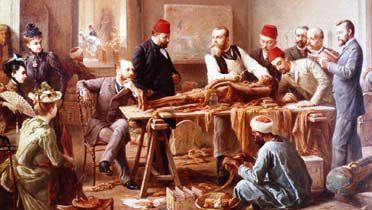
In times past, a trip to Egypt would not have been complete without bringing home a mummy or a piece of a mummy as a ‘souvenir’. ‘Egyptomania’ swept across high society, with archaeological human remains at the centre of the fascination. In the mid-19th century, Egyptologist Thomas Pettigrew was interested in the cranial shape of mummies and staged public mummy unwrappings (often at the Royal College of Surgeons). Many paying spectators attended these unwrappings, with audience members allowed to sometimes handle the mummy and its wrappings. Many referenced ‘mummy dust’ that would be inhaled upon the unwrapping and handling of the remains – Dickens himself also referred to ‘mummy dust’ in his writings. It is debated how many of these mummies were unwrapped at Victorian parties, but one cannot deny the mix of archaeology, anatomy and death would have been irresistible to the Victorians if these parties did indeed take place. The Duke of Hamilton was so taken with ancient mummies that he asked Pettigrew to mummify him upon his death – Pettigrew obliged, and the duke is apparently still sealed in a sarcophagus. Pettigrew went on to become a founding member of the British Archaeological Society, with mummy unwrappings eventually falling out of favour. It is suggested that Victorians did not feel ‘shocked’ after numerous unwrappings – if you had seen one, you had seen them all (They were probably onto looking at modern specimens at the medical museum as a means to entertain their morbid curiosity). Again, we see the Victorian fascination with death as entertainment, as a mean to satisfy the ‘dark tourist’ within them.     


A ‘mummy unwrapping’

Sources

Bates, A. W. (2006) ‘Dr Kahn’s Museum: Obscene Anatomy in Victorian London’, Journal of the Royal Society of Medicine, 99(12), pp. 618–624. doi: 10.1177/014107680609901209.

Classen, C., 2014. Touching the deep past: The lure of ancient bodies in nineteenth-century museums and culture. The Senses and Society9(3), pp.268-283.

Martens, B. (2008). Death as Spectacle: The Paris Morgue in Dickens and Browning. Dickens Studies Annual, 39, 223-248. Retrieved March 20, 2021, from http://www.jstor.org/stable/44372196

https://www.psychologytoday.com/us/blog/in-excess/201912/dark-tourism

https://www.atlasobscura.com/articles/paris-morgue-public-viewing

https://www.unjourdeplusaparis.com/en/paris-insolite/morgue-visite-favorite-paris-au-19e-siecle

https://www.atlasobscura.com/articles/victorian-party-people-unrolled-mummies-for-fun

https://historyofyesterday.com/the-macabre-history-of-victorian-mummy-unwrapping-parties-70adccfab463

Death and Sex: The Sexualisation of Victorian Women’s Mourning Attire

In 2014-2015, the Met Museum in New York held an exhibition entitled ‘Death Becomes Her: A Century of Mourning Attire’. The exhibit displayed 30 pieces of Victorian mourning attire (for female mourners) dating from the 19th and early 20th centuries. The exhibit gave a fascinating insight into the standards women were expected to uphold during their period of mourning in the 1800’s. When we think of Victorian bereavement rituals, we automatically think of the ‘widow’s weeds’ all black ensemble. And whilst we might think this attire might have been just been about death, dying and grief, it may also may have been about something else- sex. The Death Becomes Her Exhibit illustrated this point.

According to one of the curators for the exhibit, Harold Koda, “The veiled widow could elicit sympathy as well as predatory male advances. As a woman of sexual experience without marital constraints, she was often imagined as a potential threat to the social order.” This suggested that the widow’s weeds were a symbol of sexual experience- she was no longer virginal (unlike the white worn at a wedding), and likely viewed by men as a candidate for casual sex. If she was a willing participant or initiated this arrangement, as Koda remarks, she was a threat to the social order.

In her article, ‘Sex, Death, Glamour: Victorian Funeral Style at the Met’, Bess Lovejoy discusses the Met exhibit and the links between Victorian widows and sex. The widow was a figure that aroused sympathy as well as sexual appeal. The long dresses oozed glamour, with black seen as ‘becoming’. As Lovejoy states- black is chic and sophisticated, along with beautifully made mourning jewellery the ensemble must have been striking. Mirroring a wedding dress with a veil, voluminous skirt and corseted waist, one can see how the lines were blurred between sex and death when one viewed the widow’s weeds. It is even suggested in the article that death can evoke interest in the opposite sex (as studies have shown). One glamourous dress that stands out in the exhibit is the ultra-glitzy purple sequined gown Queen Alexandra wore when she was mourning Queen Victoria (It was due to Queen Victoria and her prolonged mourning of Albert that mourning periods in black became commonplace).   

Dress worn by Alexandra whilst in mourning for Queen Victoria

The burden of wearing black during the mourning period mainly fell to the woman of the house. In full mourning garb, the woman would wear all black, eventually ‘diluting’ to a ‘half mourning’ period. During this period muted colours like grey and purple were worn. The intense period of mourning could last two years before muted colours became a wardrobe stable. Death was such a regular part of Victorian society that women could be wearing black for years on end. Interestingly, it was thought that ending the mourning period early meant a woman was sexually active. To see a widow out of her mourning dress was scandalous and once again linked to sex.

Dress similar in appearance to a wedding dress

It is suggested that these dresses were used to restrain men from making sexual advances. The wearing of black in fact was meant as a deterrent to male suitors – even though this likely had the opposite effect, especially if the widow was young. Society viewed a young widow as dangerous- she was untethered by marriage but had full sexual experience. She may have been vulnerable, having lost her social and financial status through her husband, but the black dress was a reminder to many of her associations with death as well as sex.  

Sources

https://www.metmuseum.org/press/exhibitions/2014/death-becomes-her

https://www.racked.com/2014/10/28/7571465/metropolitan-museum-of-art-funeral-attire

https://www.thecultureconcept.com/death-becomes-her-a-century-of-mourning-attire-at-the-met-ny

https://www.washingtonpost.com/lifestyle/style/grief-as-a-fashion-statement-in-death-becomes-her-at-the-metropolitan-museum-of-art/2014/11/12/819527a4-65f4-11e4-836c-83bc4f26eb67_story.html

Museums and Human Remains: Repatriation, Display, and Storage.

Human remains collections in British Museums over the last 200-300 years have been an important aspect of cultural heritage, however, there have been ethical dilemmas surrounding their curation and display for several reasons. Issues arise particularly in relation to public sensitivities, ethics, and the way in which the human remains were acquired i.e. was there consent from the donor or the family of the donor? With the rise of modern medical exhibits such as Body Worlds by Gunther von Hagens gaining millions of visitors worldwide, controversy surrounding human remains display has grown. So how do the public really feel about the display of human remains, and what are the main issues that arise?
*Disclaimer: This blog post is only intended as a short overview of some important points- a full debate would be much longer, and excellent detailed sources can be found on the subject elsewhere.
Where have these remains come from?
Several factors surrounding the acquisition of human remains are controversial. One in particular is the expansion of colonial territories, and the addition of specimens acquired by ‘colonial agents’. These ‘curiosities’ may have been considered acceptable as they were displayed in a time when there were even ‘living curiosities’ on show. Colonialist ties to human remains have resulted in numerous museums beginning the repatriation process, after years of pressure from campaigners. There remains however, collections still with colonialist ties in museums today.
During the 18th and 19th centuries there were cases of ‘resurrectionists’. These were paid body snatchers that would exhume fresh corpses at the behest of paying surgeons and doctors. The trade was rife in London and Edinburgh (with Burke and Hare the most famous of these snatchers), as the only legal way to obtain a corpse was if it was one of an executed criminal. Another point to make here is the legal system was very different from today – many of those executed were only guilty of petty crimes done out of desperation. Despite the introduction of the Anatomy Act in 1832, there have still been concerns surrounding the use of unclaimed bodies from workhouses after this time, but it must be said that some of the bodies were indeed claimed with consent (but how informed was that consent? Where professionals offering desperate family members payment for their dead loved one?).
Evidently, with such dubious origins highlighted, it is no wonder there has been some questioning as to the whether some historical remains should be displayed or not. Museums however are constantly working to tackle this issue, perhaps the best may forward is to give a voice to these important pieces of cultural heritage by displaying the remains with their origins listed- even if the truth is unsettling. For the items of unknown origin, perhaps stating this fact along with suggestion as to their origins (whether unsettling or not)? Whatever the case, museums are constantly evolving, and although human remains over 100 years old are not affected under the 2004 HTA, the origins of these specimens are being taken more seriously. Many remains in the British Museum for example, were ‘gifted’ or purchased in the 19th century from places which may have had a complex relationship with death which is different from our own. Even the complex relationship of death in today’s society has been emphasised through modern pagan groups vocalising the need to rebury ancient British remains.

How are they displayed?
Perhaps the most controversial of the plastinated bodies of the Body Worlds exhibit was the sex plastinate. The questions that arose surrounded the remains, besides the displays themselves, was the sex position in which the donors were placed. Many wondered whether the donors and their families realised that this was the position they would be displayed in, highlighting that even when one donates their body that informed consent is still a burning issue. Although Body Worlds was an exhibit, not a museum, the issue of display is still rife and spills over into the heritage sector.
Within museum settings many visitors expect to see human remains on display, particularly skeletal remains. As a rule, displays are often laid out in such a manner that means visitors cannot come across them ‘by accident’. There are signs up warning the visitor if they chose not to view the exhibit. Display conditions should always be environmentally stable to ensure preservation and protection of the remains. This is particularly significant in incidences were specimens have been preserved in alcohol etc. as to prevent the evaporation of the liquid from the containers, thus rendering the specimen vulnerable to decay. The displays should have the aim to educate, explain and encourage conversation and reflection in a healthy manner. Evoking conversation and thought in the case of 18th – 19th century soft tissue allows the rise of ethical questions, as so often the public may feel more detached from older skeletal remains than preserved soft tissue.
Conclusions
The question of what to do with 18th-19th century dated human remains is never easy- particularly when soft tissue is intact as preservation and conservation is required i.e. preserving fluid. Museums and researchers are more and more informed on issues of display and consent- particularly in the wake of the Alder Hey Scandal. What is the right thing to be done with these valuable sources of information? Should they be repatriated out of respect or is it disrespectful to not utilise the information they can give us? Should they be displayed for public viewing in a responsible manner or should they be placed in storage out of view? Is this also a disrespectful way to treat these remains as they are left to sit on a shelf and viewed as obsolete? The answer is not an easy one, and it is vital that heritage institutions continue to dwell on it.

Sources
https://web.a.ebscohost.com/abstract?direct=true&profile=ehost&scope=site&authtype=crawler&jrnl=13622331&AN=123893802&h=yVZXkJLcnpChW1iCT1utHA3X4TJPctruPnhuEMN%2btIOI1VLblAB3HnTxTDNE%2f8OJlK%2fTPTU8bUYF7nSlJE5k1A%3d%3d&crl=c&resultNs=AdminWebAuth&resultLocal=ErrCrlNotAuth&crlhashurl=login.aspx%3fdirect%3dtrue%26profile%3dehost%26scope%3dsite%26authtype%3dcrawler%26jrnl%3d13622331%26AN%3d123893802
https://wellcomecollection.org/pages/WyjY_SgAACoALCmH
https://www.mummystories.com/post/body-worlds-london
file:///C:/Users/sutto/Downloads/AlbertiandHallamMedicalMuseums2013%20(1).pdf
https://londonist.com/2015/09/barts
https://www.britishmuseum.org/sites/default/files/2019-11/Regarding-the-Dead_02102015.pdf
https://www.standard.co.uk/standard-home/body-worlds-sex-couple-the-debate-6801712.html
https://londonist.com/london/features/who-in-the-world-goes-to-body-worlds
https://www.britishmuseum.org/our-work/departments/human-remains
https://www.jcms-journal.com/articles/10.5334/jcms.1021220/
https://www.britishmuseum.org/sites/default/files/2019-11/DCMS-Guidance-for-the-care-of-human-remains-in-museum.pdf https://news.artnet.com/exhibitions/the-worlds-19-creepiest-museums-65542