The Dead of the Titanic: The Mackay Bennett, Embalming, and Burial

Today marks 111 years since the sinking of the ‘unsinkable’ Titanic on her maiden voyage. The luxury liner left Southampton on the 10th of April 1912 before picking up additional passengers in Cherbourg and Queenstown (now modern-day Cobh). You can visit the Titanic centre in Cobh today, well worth a visit if you are ever in County Cork – a lesser-known centre then the Titanic Experience in Belfast, the city where White Star Line produced the vessel.

With the anniversary of the disaster, I wanted to write this blog post on the aftermath of the sinking, drawing attention to the recovery of the dead and where many were put to rest. The lesser-known vessel, The Mackay Bennett, was instrumental in recovery of bodies for loved ones.

It took the ship over 2 and a half hours to sink, finally submerging in the early hours of the morning of the 15th of April. About 1500 people are thought to have died as a result of the sinking.

The Mackay Bennett

The Mackay Bennett was a cable ship built in the 1880s. The iron ship was chartered by White Star Line once the news of the sinking had broken. The crew opted to stay on board the ship, despite being told they were under no obligation to carry out the task of recovering bodies. The ship went to the Titanic’s last known location from the port of Halifax, Nova Scotia, equipped with ice (100 tonnes), coffins 100 wooden), and undertakers who worked for John Snow and Co. Once the crew arrived at the sinking site, they were greeted with a harrowing site. Many of the dead were mutilated, and the Mackay Bennett called to warn other ships to avoid the area. The ship arrived to begin recovery on the 19th of April.

Recovery and Care of the Dead

Captain Larnder of the Mackay Bennett stated that far more bodies then expected were seen in the sea upon arriving, with boats manned by 5 or 6 crew members launched for recovery with room for 8 bodies per small boat. Over 50 bodies were recovered on the first day, fewer were recovered on the second day and 119 were recovered on the third day. Embalming fluid was also brought on the ship so chief embalmer – John R. Snow Jr. – could care for the dead. Once a body was brought aboard, it was given a number that matched a bag with their personal items. Physical characteristics, identifying features and clothing were also noted. Once all the coffins were filled and embalming fluid ran out, the bodies were wrapped in a canvas and placed on ice in the hold. Only embalmed bodies could be brought ashore, so the difficult decision was made to bury some of the bodies at sea – they were weighed down with iron bars and dropped overboard as a minister delivered a service. It was noted that the many of the bodies buried at sea were identified from their clothing as third-class passengers or crew members, with some scholars stating that the bodies ‘worth less’ were returned to the water. Many of the wealthier passengers were chosen for preservation rather than a sea burial as so insurance policies could be paid. Another ship, the Minia, eventually arrived on scene with more embalming fluid so the process of preservation could begin again. 306 bodies were recovered by the Mackay Bennett after 7 days of searching, with 116 buried at sea. The remaining victims were brought back to Halifax. 3 additional ships recovered a further 22 bodies over the following month. It is estimated that around 23% of the dead were recovered.

Reaching the Shore

A temporary morgue was set up at the Halifax curling rink. The same rink was used as a temporary morgue 5 years later when a moored ammunition ship exploded and killed around 2000 people in Halifax. The ship arrived back on the 30th of April to tolling bells and family members looking for their loved ones. Black draped hearses were set up along the dock to retrieve the bodies from the recovery vessel. Around 200 bodies were brought ashore (sources differ on exact numbers), with an area set up for identification in the temporary morgue. To assist with grieving relatives, a nurse was on hand to comfort loved ones. One undertaker collapsed from shock when he unexpectedly came across the body of his uncle amongst the victims.

Around 150 people recovered from the Titanic were buried in Halifax, Nova Scotia – over 50 victims were claimed by relatives and shipped elsewhere for internment. 3 cemeteries are the final resting place for victims in Halifax –  Fairview LawnMount Olivet, and Baron de Hirsch. These 3 cemeteries are non-denominational (FL), Catholic (MO) and Jewish (BH). An unidentified baby recovered from the water was exhumed and DNA tested in 2007 – the 19-month-old was finally identified as Sidney Godwin. His whole family perished in the disaster – they were third class passengers.

Eventually the Mackay Bennett resumed its duties as a cable carrier – retiring in 1922. The ship now lives on in the history books at the mortuary vessel for the victims of the Titanic.  

Sources

https://en.wikipedia.org/wiki/Titanic

https://www.mentalfloss.com/article/602405/mackay-bennett-titanic-mortuary-ship

https://www.encyclopedia-titanica.org/titanic-bodies-mackay-bennett/?utm_content=cmp-true

https://homepages.rootsweb.com/~capstick/titanic.html

Recovering Titanic Bodies: The Grim Task of the Mackay-Bennett

https://homepages.rootsweb.com/~capstick/titanic.html

The post-mortem fate of Elvis Presley: Another case study in bodily integrity

A while ago I did a blog post on the post-mortem fate of Marilyn Monroe, which has generated a lot of interest on my blog. Celebrities – dead or alive – have a power over us. Decades after their death they still pique our interest. Marilyn has become a hot topic once again recently in the news, with Kim Kardashian damaging her dress at the Met Gala, the release of a new Netflix documentary about her death, and with a new movie about her called Blonde set to be released soon. There has been some outcry online to ‘let her rest’ and to stop speculating in aspects of her life and death. I doubt very much that this will be the case. In fact, those posting about letting Marilyn rest are doing the exact opposite of what they are preaching. She is clickbait for many, which brings up many aspects of post-mortem bodily integrity. With the recent release of Baz Luhrmann’s new Elvis movie, I thought looking at the post-mortem bodily integrity of Elvis Presley was important. Like Marilyn, Elvis is considered one of the greatest icons of the 20th century. So how was Elvis’s body treated upon his death? First, a little bit about ‘The King’.


Who was Elvis Presley?
Elvis Aron Presley was born in Mississippi in 1935. He began his rock and roll career in 1954 in Memphis Tennessee. Despite the flamboyant costumes and the lavish surroundings Elvis became known for, he started off very poor. His musical style was inspired by blues, country, and gospel. Throughout the 1950’s his rockabilly style dominated the charts for the first time – paving the way for other rock musicians. Presley, with his slicked back black hair and thrusting dance moves, became a sex symbol. His good looks and talent meant he also became a movie star and appeared on numerous television specials. His career continued to be successful into the 1960’s, and in 1967 he married his long-time girlfriend, Pricilla. Shortly after, they had a baby girl called Lisa Marie. The two eventually divorced in 1973 but remained good friends. In the 70’s he continued to tour but his lifestyle was catching up with him. He took prescription drugs, ate fatty foods, and had a terrible sleeping pattern – it was even reported he reached 350 pounds in weight. Even at the height of his career he always lacked confidence in himself and feared slipping back into the poverty he experienced in childhood.


How did Elvis Presley die?
Elvis was found dead at his home in Graceland in 1977 at 42 years old. Like most significant cultural icons from the 20th century, his death has been met with speculation and controversy. There have been derogatory jibes made about the position he was found in (i.e., the King died on the Throne) – he was found in the bathroom, likely having died on the toilet before falling to the ground. The fact he was found with his pants down in such a vulnerable position, questions how much information should be released to the public. Is letting the public know he died on the toilet a violation or post – mortem humiliation? Ginger Alden wrote in her memoir about the position in which she found her then boyfriend, as well as how he physically looked upon his death.
Elvis was known to have had a horrific drug problem in the years leading up to his death. He also was reported to have needed a full-time nurse to help him in the months leading up to his death, and that his awful diet even consisted of cheeseburger platters. I recently read Mary Roach’s excellent book Gulp in which she talks about Elvis and his diagnosis of megacolon. He had suffered from chronic constipation due to his diet, colon condition and drug use – it is thought he died from a heart attack brought on by Valsalva manoeuvre. It has also been suggested that he died from a drug overdose that caused his heart to stop. There has also been a theory that he died from a heart attack brought on by an autoimmune condition caused by a brain injury from a fall in 1967. Whatever the case, it is clear his heart stopped very quickly.

What happened to Elvis’s body? Elvis was brought for an autopsy to establish a cause of death at Baptist Memorial Hospital – however, the results of the autopsy have been sealed from the public record until 2027 (50 years after his death). Elvis was embalmed after he was brought to Memphis Funeral Home – he was dressed in one of his famous suits and his hair/ sideburns were dyed to hide his greying hair. He was then transported to Graceland for a public viewing under the direction of his father, Vernon Presley. Vernon was also the person who ordered the results of his autopsy to be sealed, causing much public speculation and even rumours about Presley faking his death. The death of such a well – known celebrity has often come with rumours of the death being a hoax. It’s a question of whether these rumours are generated from the public in denial of the death, from ‘genuine sightings’, or from those who wish to keep their memory alive. There were rumours that the body on display at Graceland was actually a wax dummy that appeared to have ‘beads of sweat’ from melting slightly. His dead body was scrutinised by thousands of people, even though the opened end of the casket was placed slightly out of sight of fans.

Over 30,000 fans were let into the foyer of Graceland to view the open casket before a scaled back funeral service was held at the estate. There were reports that some of fans fainted upon seeing the casket. Friends and Co-stars of Presley were present at the small ceremony before 80,000 fans followed the funeral procession to the burial at Forest Hill Cemetery. He was buried next to his mother, Gladys. A BBC presenter discussed the interaction he had with the family upon viewing the body of the star. Michael Cole was one of the first to view the body and in a Daily Mail article he commented that the head (of a deceased Elvis) was the size of a ‘watermelon’ and he was ‘deathly pale’. He goes on to say he speculated the bloating of the body was from drug use and that the hairstyle that had been done by the hairdresser at the funeral home ‘upset’ him. Like Marilyn, we see that even in death, the appearance of public figures is (and was) commented on. Even the dead are not ‘off limits’ and expected to look their best.

Unfortunately, there was an attempt made to steal the remains of Presley and his mother in the same year as his death. Nine days after the burial, Raymond Green, Eugene Nelson, and Ronnie Adkins attempted to steal the corpse with the intention of holding it for ransom. It was reported they had explosives with them to blow open the mausoleum, and the heavy, copper casket. The casket had been so heavy in fact that eight pallbearers were needed. There has been accusations made against the Presley family themselves, suggesting they were part of the plot to indicate that Elvis should be buried elsewhere – i.e., at Graceland. Initially, burial of Elvis at Graceland was not permitted by the Memphis board. If the body was elsewhere and required security, then surely it would make sense for him to be buried at Graceland where it could be safe? Specifically, his father Vernon – the same man who allowed for public viewing of the casket – has been most associated with the plot. Even more disturbingly, it was suggested that Vernon wanted his son moved to Graceland to generate more income from fans and tourists visiting the estate. If that is true, then even the remains of the King were being seen as something to generate wealth. Some speculate that none of the Presley family are actually buried at Graceland and that their bodies are elsewhere for family members to visit them privately.

In 2010 the Chicago Tribune reported that the embalming tools used on Elvis were being put up for auction by the embalmer who looked after his body. One cannot deny how much of a violation of trust this is. Those working in the death care industry have a responsibility to respect the dead and their families. The ‘John Doe’ tag, rubber gloves, forceps, lip brushes, a comb and eyeliner, needle injectors and aneurysm hooks all allegedly used at the funeral home were up for auction. The lot was eventually withdrawn, not because it was disrespectful to the memory of Presley, but because the authenticity of the tools was brought into question.

Elvis can be considered one of the greatest icons of the 20th century, and continues to generate wealth, conversation and an extraordinary fanbase. It is sad to think that one of the greatest musicians and sex symbols of the 20th century met such an untimely end. His headstone now reads ‘Elvis Aaron Presley’ – Aron is spelled incorrectly, a heart-breaking realisation when you understand that one of his greatest fears was to be forgotten.  

Sources

Roach, M., 2013. Gulp: Adventures on the alimentary canal. WW Norton & Company.

https://www.liveabout.com/details-of-elvis-presleys-funeral-2522426#:~:text=Elvis%20was%20embalmed%20at%20the,30%2C000%20fans%20were%20let%20in

http://www.autopsyfiles.org/reports/Celebs/presley,%20elvis_report.pdf#

https://www.cheatsheet.com/entertainment/elvis-presleys-corpse-was-almost-stolen-and-held-hostage-by-grave-robbers.html/

https://www.express.co.uk/entertainment/music/1325304/Elvis-funeral-death-coffin-where-is-Elvis-buried-fans-Graceland-Vernon

https://www.chicagotribune.com/news/ct-xpm-2010-07-21-ct-talk-elvis-autopsy-auction-0722-20100721-story.html

https://www.express.co.uk/entertainment/music/1226950/Elvis-Presley-death-died-of-heart-attack-father-Vernon-funeral-grave-fans-music-date-age

https://www.independent.ie/entertainment/music/elvis-autopsy-tools-withdrawn-26665559.html

https://www.academia.edu/4603315/Did_Elvis_Fake_His_Death

https://www.mirror.co.uk/3am/celebrity-news/elvis-presley-constipated-4-months-23395093

https://www.dailymail.co.uk/news/article-6060861/BBC-reporter-Elvis-Presley-dead-coffin-admits-new-truths.html

https://en.wikipedia.org/wiki/Elvis_Presley

The Death of Anne Lister: Her Post-Mortem Fate

Anne Lister – her life and diaries have gained fame in recent years, especially since the release of the hit tv show Gentlemen Jack starring Suranne Jones. Anne was born in 1791 and began writing her diaries at the age of 15. She was a businesswoman and ran her family estate – Shibden Hall- in Halifax, West Yorkshire. Anne dressed head to toe in black (a woman after my own heart), was an extremely independent woman, and had numerous lesbian affairs. She is often called the ‘first modern lesbian’ and thought of her life partner, Ann Walker, as her wife. The two took sacrament together is a ‘wedding ceremony’ at Holy Trinity Church in York. A plaque dedicated to their union was unveiled there in 2018.  Anne’s’ life was chronicled so much in her diaries, but what about her death? How and where did Anne die? Where is she buried now?

Horner, Joshua; Anne Lister of Shibden Hall (1791-1840); Calderdale Metropolitan Borough Council; http://www.artuk.org/artworks/anne-lister-of-shibden-hall-17911840-21162

Anne was an avid traveller, has produced volumes upon volumes of travel writing. In 1840 she travelled to Georgia as part of a prolonger trip with her partner Ann Walker. The two had begun the trip in 1839, and had travelled to Scandinavia, the Netherlands, Belgium, and Russia before reaching Georgia. Anne recorded a nasty insect bite she obtained in Georgia in August of 1840. A virulent fever prolonged her death, she suffered for six weeks before dying in the September – she was only 49 years old. It is reported that it took Ann Walker over six months to bring her body home. Her death was reported in the Halifax Guardian on Halloween, reporting that:

We are informed that the remains of this distinguished lady have been embalmed.

Anne’s body is believed to have been brought to Moscow for embalming. Ann Walker ensured her remains were to be transported back to England via Turkey by sea. There has been some suggestion that Anne’s remains would not have been embalmed as the arterial technique was not widespread at the time. However, it may be the case that Anne was partially embalming in some manner that may not have been arterial. Apothecary embalming practices pre-date arterial embalming and may have been used in some manner in the preservation of Anne. Viscera may have been removed and herbs/ alcohol may have been used. Embalming in the 18th century was often thought to be reserved for the likes of royalty, but Anne was a wealthy woman of noble birth who was to be repatriated in the 19th century, meaning her death was not a normal circumstance. Although Jean Gannal did not develop arterial embalming fully until 1841 – arterial system preservation was being practiced in anatomical specimen preservation. John Hunter was quite a prolific ‘preparer’ of specimens in Britain during the 18th century, and William Harvey’s work on the circulatory system had been published in the 17th century. Anne’s body was reportedly brought to Moscow for preservation, it is not inconceivable that scientific endeavours in the city allowed for her to be embalmed to some extent.

The font at Halifax Minster where Anne was baptised

As well as being preserved, Anne was also placed in a lead lined coffin or lead shell which was then placed inside another wooden coffin. It was lawfully required for a prolonged period in the 19th century for coffins to be lead-lined to allow for leakage prevention. Her body finally reached Shibden Hall in Halifax in April 1841 – over 6 months after her death. Her funeral was reported to have been attended by thousands of people, with crowds gathered in the streets. The funeral procession consisted of typical Victorian funeral traditions, including a hearse, coaches, and carriages. Anne is one of many Listers to be buried at the minster, but she is by far the most famous. Her exact burial place is not known as her tombstone was broken and moved in the 1870’s (many assume she is buried in the family vault which is located somewhere in the church). It was not found again until 2000 and is now on display at the minster. Listers tombstone still has flower offerings laid on it today, and there are calls from many, including Sally Wainwright, creator of Gentlemen Jack the tv show, for her exact resting place to be located. Over 150 years after her death, the location of Anne’s body is still in the minds of many who are inspired by her and her resilience. Even in death, Anne Lister still interests and captivates people.

Anne Lister’s Tombstone at Halifax Minster

Sources

https://museums.calderdale.gov.uk/famous-figures/anne-lister

https://en.wikipedia.org/wiki/Anne_Lister#:~:text=Lister%20died%20on%2022%20September,Minster%2C%20on%2029%20April%201841.

https://www.historyextra.com/period/victorian/anne-lister-real-gentleman-jack-diary-code-history-secret-life-britain-first-modern-lesbian/

https://northernlifemagazine.co.uk/the-mystery-of-gentleman-jacks-tombstone

https://www.yorkshirepost.co.uk/heritage-and-retro/heritage/gentleman-jack-creator-sally-wainwrights-call-for-anne-listers-burial-spot-to-be-found-3642920

https://www.packedwithpotential.org/stories-articles-writeups/where-is-anne-lister-halifax-minster/where-is-anne-lister-halifax-minster-v3

Damon, A.B., 2020. Anne Lister,“A Sundial in the Shade”: A Gifted Woman in the Nineteenth Century. Women’s Studies49(2), pp.130-148.

Zigarovich, J., 2009. Preserved Remains: Embalming Practices in Eighteenth-Century England. Eighteenth-Century Life33(3), pp.65-104.

https://artuk.org/discover/stories/lesbian-love-and-coded-diaries-the-remarkable-story-of-anne-lister

A Bearded Woman, Embalmed: The post-mortem display of Julia Pastrana in the 19th century

Who was Julia Pastrana?
Julia Pastrana was a Mexican woman born c.1830-34 in the Sierra Madre region. Julia suffered from a disease known as hypertrichosis, among other conditions. Standing at no more than 4ft 5 inches, Julia’s face and body were covered in hair, and her overgrown gums cause her mouth to protrude in a grotesque manner. There is much uncertainty surrounding her early years, with rumours stating she was sold by her parents or abandoned in the wilderness before being stumbled upon and rescued. Eventually she was adopted by Governor Sánchez in Sinaloa and worked as his maid before leaving his employment in 1854. The ambiguity of her early years is likely due to suppression of the truth by the freak show circuit who wanted to make audacious claims about her origins (including that she was a ‘unholy union of man and beast’).

Julia Pastrana

Life as the ‘Bear Woman’ or the ‘Baboon Lady’
Julia was likely recruited to become a member of a ‘Freak Show’ by an eager entrepreneur, and she began to tour under the showman Theodore Lent who she would marry in 1855. She went on tour in numerous cities across America before debuting in London in 1857, all the while under the direction of her husband who used her body for profit in both life and, eventually, in death. Control was likely the reason Lent married her, as seen when P.T. Barnum met her in 1857. She would not remove her veil for him until her husband entered the room. Pastrana went on to tour across Europe under the supervision of her husband, making sure she performed on stage, submitted to examination, and posed at social functions.

Death and embalming
Julia died in childbirth in 1860 along side her baby son who had also inherited her condition. She was in Moscow at the time, and Lent sold her body (as well as their baby’s) to a Professor Sokolov of the Anatomical Institute at the university so he could embalm them. The embalming technique used by Soklov was a success, with many praising his experimentation to benefit anatomical collections. His method was thought to blend aspects of both mummification and taxidermy, with the whole process taking around 6 months. The colour and texture of the corpses gave them a wax work like appearance, and images of her dead naked body and her son’s during the embalming process were published for academic research. Lent reclaimed the bodies in 1862 and began to tour with them as ‘curiosities’. Her display in death continued to allow her husband to profit from her body, in death it was easier for the public to view her body and discuss her openly in medical fields- she had become more object than person as she could be displayed for however long Lent required.

Image of Julia

What happened to the bodies?
Lent went on to marry another ‘bearded lady’ called Marie Bartel, presenting her as Zenora Pastrana, the little sister of Julia. Like Julia, Marie performed on tour for her husband before he was committed to an asylum in Russia after he began to lose his mind. He died shortly afterwards, and Marie sold the bodies. They were displayed at numerous exhibits across Europe for years to come. The bodies were touring up until as recently as the 1970’s until Sweden banned the exhibition in 1973 putting a stop to the display of the corpses. A break-in to the storage facility in 1976 where the bodies were kept resulted in extensive damage to the body of Pastrana’s son- the corpse was disposed of and Julia was moved to the University of Oslo.

In 2005, petitioning began for the repatriation of Pastrana back to her native Mexico. After over a decade of campaigning by artist Laura Anderson Barbata, Pastrana was brought back to her native home in 2013. She was laid to rest in a white coffin after a Catholic mass. Finally, Julia was given a dignified end to her story.

The story of Julia Pastrana is tragic and unsettling. Bodily autonomy in life and death was taken from Julia without her say in the matter. After a lifetime of scrutiny surrounding her appearance, despite Julia showing intelligence and a loving nature, this only continued at the hands of her husband after her death. To Lent, his wife was profitable, and whats even more disturbing is the fact that Lent did not seem upset in anyway to display his dead wife and son years after their passing. This questions his motive behind the marriage in the first instance, with the union likely more of a business plan than a loving partnership to the scrupulous businessman. It took years of body on display and a decade long campaign for Julia to finally be laid to rest- even then it is sad to think this would not have happened organically were it not for the relentlessness of Anderson Barbata.

Julia on displayed after her death

Sources

https://wellcomecollection.org/works/z9f8368a

https://www.buzzfeed.com/timstelloh/behold-the-heartbreaking-hair-raising-tale-of-julia-pastrana

The Sad, Grotesque Life of “Baboon Lady” Julia Pastrana

https://www.bbc.co.uk/news/world-latin-america-21440400

https://publicdomainreview.org/essay/julia-pastrana-a-monster-to-the-whole-world

https://www.sciencedirect.com/science/article/pii/S1875067216300827

https://journals.sagepub.com/doi/pdf/10.1177/003591577406700229https://ore.exeter.ac.uk/repository/bitstream/handle/10036/3599/PettitF.pdf?sequence=1

‘World’s Ugliest Woman’ Finally Given a Dignified Burial, 153 Years After Her Death

Embalming: A Help or Hindrance to Grief? A Personal and Professional Experience

Whilst many European countries do not feel the need to embalm their dead, Ireland is not one of them. Growing up in rural Catholic Ireland, I was exposed to the deceased bodies of loved ones from a very young age as it is tradition for us to ‘wake’ our dead at home. I was eight years old when I saw my first dead body, it was that of my grandfather who had died from a long battle with lung cancer. I remember seeing him a day before he died, he was struggling to breathe, gaunt and his skin had yellowed. It scared me to see him like this, so I was apprehensive seeing him in the coffin that was placed in the living room of my grandparents’ house. But he had transformed from the ill man I had seen the night before to someone who looked the peaceful picture of health. I did not know it at the time, but I came to realise it was the embalmer who had been responsible for this transformation. I lost other grandparents, cousins, aunties, uncles, and parents later down the line and was never afraid of viewing them in their coffin because of the peace I felt at seeing my grandfather.


I recently came across an article on time.com by Sallie Tisdale who discussed viewing her mother after she had died of breast cancer. She describes the transformative type process I just described seeing my grandfather, but for her the experience was overwhelmingly negative. She felt acceptance of her loss was hindered by the viewing, as her mother was made to ‘look alive’. Tisdale asks the important question, ‘why do we so often make a dead person appear alive?’
Caitlin Doughty of the Order of the Good Death does an excellent job of educating the public on embalming practices in America. Doughty does a series of YouTube videos (Ask a Mortician Channel) discussing what happens to a body during embalming. On the Order of the Good Death Websites there is plenty of information about how embalming became common practice (spoiler- The American Civil War played a large part) as well as the dangers and myths associated with dead bodies and the practice itself. Doughty does not condemn the practice but makes sure that the public know it is not always necessary, it can often be an extra cost to families.

From personal experience, embalming has helped immensely in the grieving process. My Father passed when I was 19 years old very suddenly in an accident and he was embalmed as part of the Catholic wake tradition. However, it was my Mother’s death when I was 25 years old where I felt embalming personally helped my grieving. My Mother died of brain cancer and had been ill for quite some time before her passing. She was only 50 years old when she died and had always looked quite youthful for her age until the disease began to progress. She was a shadow of her former self in the care home she was in, she had swollen limbs from excessive medication, her complexion was pale, and she was constantly agitated and confused. On her passing, seeing her in the funeral home after her embalming felt like a huge relief. She looked like her glamourous self again, more peaceful in death than she had been in life. Unlike Tisdale, I was appreciative of the practice as we had a chance to say goodbye to our Mother in the way we wanted to remember her. This may also have been down to differences in the work and skill of each embalmer, our embalmer did not go overboard with any makeup etc. Two weeks after her death I began assisting an embalmer and understood the practice fully. Whilst the practice itself is quite invasive, I was fascinated by it and asked the mortician about families who opted out of the practice. He told me they always make sure families know the extras costs and tell them it is not always necessary, but some still feel the need to go ahead with the embalming as it is how they grieve. What is important here is that families know their options, and the funeral home are not exploiting people when they are vulnerable.


There have also been suggestions that embalming has psychological implications in American society. Psychologists have suggested that embalming can be considered a ‘final assault on the self’ and that the natural looking deceased can encourage denial of death in loved ones. There is also some suggestion in other studies that there was more regret surrounding not viewing the body than having the body embalmed. Again, personal preference plays a large role. One lady describes how viewing her mother after she was embalmed disturbed her, but it brought her brother peace.


As someone with a background in archaeology, with an interest in how we preserved the dead in the past (as educational specimens and as part of funeral rites), it is no wonder this has interlinked with my professional life. Although modern embalming methods are strongly linked to the American Civil War, different cultures from all over the world have been preserving their dead in various ways as part of their grieving process for thousands of years- in the same way that many have not. It comes down to understanding the various options out there, and what works for some does not work for others. So, does embalming hinder the grieving process? The answer will never be the same for everyone.

Sources

http://www.orderofthegooddeath.com/resources/embalming#4
https://time.com/5542117/death-embalming-preservation-cremation-mourning/
https://www.bbc.co.uk/news/av/uk-21724769/embalming-allows-people-to-initiate-grief-process
Palermo, G.B., Gumz, E.J. The last invasion of human privacy and its psychological consequences on survivors: A critique of the practice of embalming. Theoretical Medicine 15, 397–408 (1994). https://doi.org/10.1007/BF00993797
https://www.funeralbasics.org/what-is-embalming/embalming-and-grief-process/
https://www.bmj.com/content/340/bmj.c2032
https://www.verywellhealth.com/what-is-embalming-1132124

The Depiction of Embalming in Art: From Pharaohs to Presidents.

Embalming has been carried out for thousands of years by different cultures all over the world. An array of techniques concerning the practice have been described by scholars and doctors from each of these time periods, but selection of artists have depicted this practice as well. Embalming cannot be called a common subject matter in the field of art history- but nevertheless there are still examples that survive today. As part of this blog post I will discuss five works of art that depict the practice of embalming, a topic I do not believe is widely discussed through the examination of such materials. I will attempt to cover different embalming techniques as well as different time periods and locations in their examination.


Papyrus of Hunefer, Egypt- c.1275BC. and New Kingdom Tomb of Sennedjem, Egypt- c.1250BC.

Numerous depictions of funerary rites and embalming are depicted in Egyptian papyri, on sarcophagi and other objects. I have chosen the Papyrus of Hunefer from the British Museum which shows the Opening of the Mouth ritual. The embalmer is depicted wearing a mask of Anubis (the god of embalming) and the mummy is being reanimated by the priest so the deceased could speak in the afterlife. We also see an embalmer depicted during the mummification process wearing a jackal head in the New Kingdom tomb of Sennedjem. The deceased in the papyrus is depicted as already ‘mummified’ by the embalmer before the final step of the ceremony takes place and the deceased can be laid to rest. The embalming process would have been subject to expense- with the most elaborate process costing the most money. Organs were removed and placed in canopic jars, the body cleaned and sewn up and dehydrated with natron. The process took around 70 days.

Tomb of Sennedjem
Papyrus of Hunefer

Embalming of the Body of Christ triptych, Rotterdam, Unknown Master- c.1410.
This 15th century triptych shows the embalming of Christ- a very rarely depicted scene in religious art. In the image we see Mary embracing her son as she is supported by John the Baptist, Mary Magdalene, Mary of Cleopas and Mary Salome in her mourning. The jars of oils, resins and spices used in the embalming process can be seen around the feet of Christ, with men (presumably the embalmers) handling equipment to assist in the preservation. The Bible mentions the embalming of Christ. His body was washed and perfumed with substances such as myrrh and aloe before his resurrection. However, there is no mention of organ removal and it is likely the body was perfumed for pomp and display. It is strange that the topic of the embalming of Christ is not depicted more often, as it links so closely with resurrection and preservation of the body.

The centre image depicts the embalming of Christ

The Embalming Jars of Friedrich Ruysch, Thesarus animalium primus, 1710.
The Dutch anatomist Ruysch is remembered for his development of anatomical specimen preservation and use of the arterial method of embalming. He acquired a very large specimen collection and created carefully arranged scenes incorporating human body parts and preserved animals. The scenes were intended to be an art display as well as a scientific preservation. Images of his artistic ‘embalming jars’ were featured in his Thesarus animalium primus in 1710. His collection of ‘curiosities’ notably contained infant and fetal remains posed among botanical landscapes.

One of the ’embalming jars’

Embalmed Body of Abraham Lincoln at Springfield, Illinois, Engraving, 1865.
The American Civil War saw with it the popularisation of embalming methods so deceased soldiers could be brought home to loved ones. Lincoln was a huge advocate of the practice and had his 11-year-old son Willie embalmed upon his death in 1862. The same embalmer would go on to embalm Lincoln himself after his assassination. At the time, embalming was carried out using alcohol, mercury or arsenic via the arterial method, and makeshift embalming tents were often put up at battlefield sites. After Lincoln was embalmed his body went of a ‘tour’ for public display in different cities in America. This engraved illustration shows the embalmed body on display in Springfield, Illinois. The book the image came from was entitled ‘Illustrated life, services, martyrdom, and funeral of Abraham Lincoln, sixteenth President of the United States : with a portrait of President Lincoln, and other illustrative engravings of the scene of the assassination, etc’ by D. Williamson and G. Bancroft, 1865.

The embalmed body of Abraham Lincoln on display in Springfield, Illinois

Embalming is seen in a lot of artistic mediums but is not a popular subject matter. Interestingly, funeral processions and anatomical dissections were quite popular related subject matters for artists- both have themes strongly relevant to death and the human body. However, this snapshot of art pieces has shown mediums in painting, illustration, and sculpture over numerous time periods in different parts of the world. Preservation of the human body is still preserved in the art and archaeological material that we can still examine today.

Sources
https://www.codart.nl/museums/museum-boijmans-van-beuningen-acquires-pre-eyckian-embalming-of-the-body-of-christ/
http://art-in-space.blogspot.com/2014/10/anonymous-embalming-of-body-of-christ.html
https://www.britishmuseum.org/collection/object/Y_EA9901-3
https://en.wikipedia.org/wiki/Ancient_Egyptian_funerary_practices#/media/File:Opening_of_the_mouth_ceremony_(cropped).jpg
http://egypt.hitchins.net/the-three-kingdoms/the-tomb-of-sennedjem.html#:~:text=The%20Tomb%20of%20Sennedjem,tomb%20in%20the%20village%20necropolis.
https://www.nationalgeographic.com/history/magazine/2017/03-04/egyptian-mummification-technique-process-purpose/
https://theconversation.com/how-lincolns-embrace-of-embalming-birthed-the-american-funeral-industry-86196
https://www.flickr.com/photos/internetarchivebookimages/14782342695/in/photostream/
https://theconversation.com/how-lincolns-embrace-of-embalming-birthed-the-american-funeral-industry-86196
https://www.medicaldaily.com/how-it-works-science-and-art-embalming-365530
https://archive.org/stream/illustratedlif2293will/illustratedlif2293will#page/131/mode/1up
https://publicdomainreview.org/collection/the-embalming-jars-of-frederik-ruysch
https://en.wikipedia.org/wiki/Frederik_Ruysch
https://www.nlm.nih.gov/exhibition/dreamanatomy/da_g_I-C-1-03.html
pathologicalbodiesproject.home.blog/2019/12/06/embalming-fluid-in-archaeology-what-did-we-use-to-preserve-our-dead-the-discussion-of-four-bodies/
Gannal, J. (Jean-Nicolas)., Harlan, R. (1840). History of embalming: and of preparations in anatomy, pathology, and natural history; including an account of a new process for embalming. Philadelphia: J. Dobson.

The Embalming of Maria Van Butchell by William Hunter and William Cruickshank, 1775.

I recently read Kate Lister’s fantastic book ‘The Curious History of Sex’. In one of the chapters entitled ‘Boy’s Toys: The History of the Sex Doll’, I was struck by the story of Maria Van Butchell. She was embalmed by her husband, Martin Van Butchell, in 1775 for the purposes of public display. For this blog post, I explored the embalming further and the life of the eccentric 18th century dentist, who worked closely with some of the most famous anatomists of the time.
Van Butchell (born in c.1735) trained under the famous surgeon John Hunter and became interested in dentistry. He charged highly for his dentistry services (he was a very capable dentist), and he became known for his eccentricities as well as his surgical skill (sometimes he was referred to as a ‘kook’). He specialised in anal fistulas and haemorrhoids as well as dentistry and was considered to have had a strange way of dressing himself at the time. However, the oddest thing he is known to have done involved his wife, Maria (sometimes referred to as Mary).
On the 15th January 1775, Maria died. Van Butchell asked the surgeons William Hunter and William Cruickshank to embalm her so she could be displayed as part of his dental practice. Embalming of loved ones was not commonplace at the time, making the request even stranger still. It is difficult to untangle what was actually used in the embalming method, but sources suggest she was ‘stuffed’ with ‘powdered nitre’ and injected with carmine, turpentine and wine in order to give her a ‘rosy glow’. She was also reported to have been dressed in her wedding dress and given two glass eyes. Finally, after a thin paste of plaster Paris was applied, Maria was placed in a glass topped coffin for display in the drawing room for patients to look at.

Quack dentistry was a booming business at the time, but the presence of Maria meant Van Butchell had to put an advertisement in the newspaper stating only a limited number of persons could visit the practice every day. It was evident her presence seemed to be good for business. Despite the embalming being carried out by two renowned anatomists, the preservation method had not been perfected at the time and many referred to Maria as a ‘repulsive’ object who eventually began to decay. Van Butchell remarried a woman named Elizabeth, who understandably protested the presence of Maria in the drawing room. Maria’s body was eventually donated to the Hunterian Museum for display in 1815. She remained there until the body was destroyed in a German bombing in 1941.
So why did Van Butchell embalm Maria? Understandably, one cannot help but notice the misogyny of the time at play. It was reported that Van Butchell had a clause in his marriage contract that allowed him to use Maria as property when she remained ‘above ground’. Maria was his property in his eyes- something he could do with whatever he wanted. As Kate Lister discusses in her book, there are disturbing necrophiliac undertones associated with her embalming. A disturbing epitaph that accompanied her in the Hunterian Museum even referred to her as ‘A much-loved wife at home to keep, Caress, touch talk to, even sleep…’. One can fully understand why this embalming example shows up in the sex doll chapter of Lister’s book. Van Butchell was also known to be dogmatic in life, demanding Maria only wear black and his second wife Elizabeth only wear white as contrast. Even before her embalming, Maria was still regarded as a ‘doll’ that could be dressed how he liked- in her death, Van Butchell carried on this tradition.

Sources

Christen AG, Christen JA. Martin Van Butchell (1735-1814): the eccentric, “kook” dentist of old London. J Hist Dent. 1999;47(3):99‐104.
Lister, K., 2020. A Curious History of Sex. Unbound Publishing.
Watkins D. The strange tale of Martin van Butchell. Br Dent J. 1989;167(9):319‐320. doi:10.1038/sj.bdj.4807021
https://www.rcseng.ac.uk/library-and-publications/library/blog/martin-van-butchell/
https://londnr.com/dead-wives-and-dentistry-martin-van-butchell/
https://funlondontours.com/lorem-ipsum/
http://thelondondead.blogspot.com/2014/01/maria-van-butchell-died-1775-hunterian.html
https://shootingparrots.co.uk/2013/12/11/v-is-for-martin-van-butchell/
https://www.weirdhistorian.com/van-butchell/

Ancient Egyptian Embalming in Gaming: Assassins Creed Origins

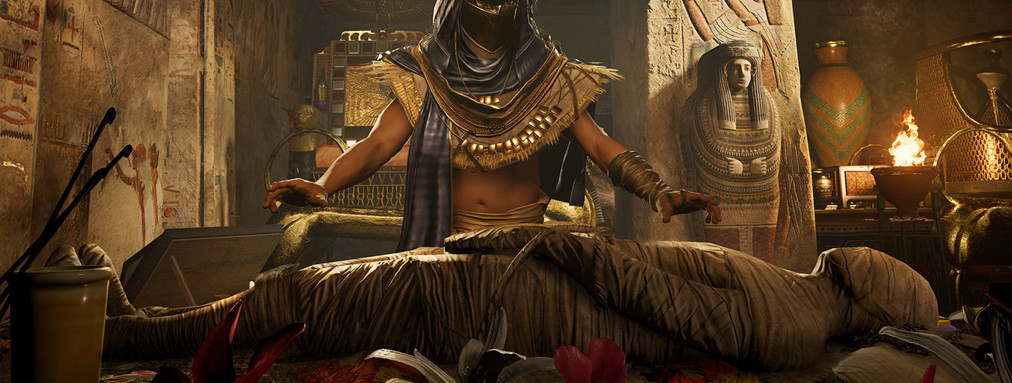
Assassin’s Creed is one of the most successful video game franchises of all time, with Origins being the tenth instalment in the series. It is a stealth video game, with this version set in the Ptolemaic period (49-47BC) in Egypt and recounting a fictional history of the rise of the disposed Cleopatra VII. As an archaeologist it was no surprise the Ancient Egyptian setting was intriguing to me, but as someone who works with an embalmer and has an interest in the practice in historical settings, the depiction of ancient embalming practices was particularly engrossing.
Players have certain ‘quests’ they must complete to level up in the game, the player takes on the role of a Medjay named Bayek and his wife, Aya. The Medjay were semi-nomadic people who are mentioned as warriors and herders in Ancient Egypt who served with the military, but their name became synonymous with policing in the Egyptian New Kingdom that it was used for any ethic background in forces of authority. Many of the quests and dialogue in the game involve interactions with the embalmers as well retrieval of bodies of loved ones.

Birth Right and The Man Beast:
In the quest ‘Birth Right’, an interaction has Bayek speak with the embalmer about three bodies that are laid out in natron salts. Natron was a naturally occurring salt in the Nile Delta. Sacks of the salts are seen as well as rolls of bandages against the walls. As the two men interact, we can see the small embalming quarters that is used for members of the public not able to pay for an elaborate burial in a village. Methods of embalming were subject to cost and it is seen that no organ removal is occurring- indicating families are opting for the cheaper options of the burial rite. A body is bound tightly in bandages on the table and an assortment of jars are placed on the table next to it. The jars on the table likely contain resins and perfumed oils used in the mummification process, the set up looks almost identical to the embalming cache found in the tomb of Tutankhamun- even though his death occurred c.1300 years prior to when this game is set. As seen in the game, the cache contained linen for bandaging and sacks of natron for dehydration. Embalming was still an important aspect in Egypt over millennia and became an important aspect of burial for all classes.


In Krokodilopolis, as part of the quest ‘The Man Beast’, rotting body parts have washed inshore from far upstream after numerous people have gone missing. Bayek tracks down the source to a cave filled with half eaten corpses and learns an embalmer is stealing them and feeding them to the crocodiles in front of spectators as part of a show. Considering the importance placed upon the rites associated with death in Egypt, this would have been considered a serious crime and unlikely have been carried out by an embalmer. Interestingly here is the mention of the god Sobek, the fertility god associated with the crocodile- there has even been examples of embalmed crocodiles in Egypt dated to c. 2000 years ago.

The Ibu or Ibw area of the Wabet

Odour Most Foul:
It is in the quest ‘Odour Most Foul’ that we see the most game play associated with embalming. Priests pray to Osiris who does not rot and ‘know corruption’. According to Ancient Egyptian beliefs Osiris was the first to be embalmed by the jackal headed god called Anubis, resulting in Osiris’ resurrection- Anubis was the god of embalmers and are often depicted wearing a jackal headdress (also seen in advertisements for the game). In Origins, Memphis is becoming overpowered by a stench and the player must enter an underground tomb to investigate after speaking to the priests. The underground tomb is filled with bandaged, mummified bodies and canopic jars. Some of the mummies are rotting beneath the wrappings, indicating fault lies with the embalmer as the wrappings are sound. The player must go to the wabet (‘pure place’) and investigate the mummification process, which differs a great deal in size from the small embalmers found in the village in the ‘Birth Right’ quest. The use of the word ‘wabet’ in the game is accurate as this was the place where purification/ mummification took place in the Ptolemaic and Roman Periods. The wabet often had an open court like appearance as seen on this mission. The embalmers are heard praying to the god Anubis and numerous bodies in various stages of preparation are shown in the temple. The gate to the ibu (or ibw) is shown, where the families of the dead bring their bodies. The embalmers wash down the bodies of the dead here, also an accurate use of the term at this stage in the purification process- ibw also mean ‘place of purification’ in this period.

An embalmer with the head of Anubis


The next scene shows an embalmer removing the organs of the dead, an important process in the highest class of burial, and four canopic jars are seen in front of the body- used to hold the main organs of the body. Incredibly, the four jars are the correct anthropomorphic figures, the liver was protected by human-headed Imsety, the lungs by ape-headed Hapy, the stomach by the jackal-headed Duamutef and the intestines by the falcon-headed Qebehseneuf. After the burial, these vassals were placed in the tomb along with mummified deceased body- as seen as the player first investigates the smell coming from the underground chambers.
The next step using natron as a dehydrator is shown, with the embalmer commenting of how it burns his hand. After 70 days the bodies would have been removed and returned to the families for burial- accurately, we see the human shaped, wooden cases the family would have used to transport their loved one to their place of rest. Bayek discovers that the stench from the bodies is due to Natron tainted with sand.

Organ removal with canopic jars at the foot of the bed


Despite embalming being a complicated process in Ancient Egypt, highly dependent on time period and location, Assassins Creed Origins does quite a good job of portraying mummification and the job of embalmers. The important steps in the process are outlined and it is clear that the developers have consulted professionals when depicting the scenes. This was a particularly chaotic period, with the Ptolemaic period coming to an end and the deposition of Cleopatra VII, and beliefs in mummification practices were developed and altered over time. Origins does a very good job at giving the player a picture of life an as ancient embalmer.

Sources consulted

https://oi.uchicago.edu/museum-exhibits/nubia/pan-grave-culture-medjay
https://en.wikipedia.org/wiki/Assassin%27s_Creed_Origins#Synopsis
https://www.metmuseum.org/art/collection/search/548838
Kipfer B.A. (2000) Ww. In: Encyclopedic Dictionary of Archaeology. Springer, Boston, MA
https://www.academia.edu/907351/Ancient_Egyptian_funerary_practices_from_the_first_millenium_BC_to_the_Arab_conquest_of_Egypt_c._1069_BC-642_AD_The_Heritage_of_Egypt_vol._2_no._2_issue_5_May_2009_Cairo_2009_12-28
https://www.academia.edu/271030/In_Preparation_for_Regeneration._The_Wabet_in_Temples_of_the_Ptolemaic_and_Roman_Period
https://www.smithsonianmag.com/smart-news/ancient-egyptians-hunted-then-mummified-crocodiles-180973197/
https://www.ancient.eu/Egyptian_Burial/
https://birminghamegyptology.co.uk/virtual-museum/toward-the-horizon/osiris-the-mythological-origins-of-mummification/
https://www.ancient.eu/article/44/mummification-in-ancient-egypt/
https://www.metmuseum.org/art/collection/search/587568
https://www.youtube.com/watch?v=9kGFbj6iBFY
https://www.youtube.com/watch?v=0iIoPw-SvC0
https://www.game-debate.com/news/23470/assassins-creed-origins-will-have-huge-pyramid-tombs-based-on-real-layouts
https://www.ubisoft.com/en-gb/game/assassins-creed-origins/

Plastination: Life (and Death) in Plastic, it’s Fantastic?

The body preservation method of plastination has rose to prominence in recent years with the touring of the Body Worlds exhibition. Despite all the controversy surrounding the exhibit, i.e. the ethics of cadaver display, the origins of the cadavers and the famous ‘sex plastinate’, one cannot deny the impressive development of the method. Plastination was created and has been pioneered for years by the German anatomist Dr Gunther von Hagens. The method was invented by the anatomist in 1977. Von Hagens was working as a scientific assistant and was trying to improve the quality of the renal specimens he was working with in his lab. It was this experimentation that resulted in the process known as plastination. The method involves replacing water and lipids with curable polymers (i.e. silicone, epoxy, polyester), these substances will harden, and the result leaves an odourless, durable specimen. Plastination is becoming more prominent in areas of teaching, their long-term survival is appealing to Anatomy departments but there are issues with the rigidity of the specimens. Sometimes this prevents demonstrations of joint movement to students and prevents in depth dissection of hidden features.

Despite some limitations, plastination is an excellent method for displaying cadavers. The Body Worlds website outlines four steps in the plastination process. These include:

  1. Fixation using formaldehyde (takes 4 hours) and dissection of skin, fatty and connective tissues (takes 500-1000 hours).
  2. Removal of water and body fat using an acetone bath at freezing temperatures.
  3. Forced impregnation of liquid polymers after acetone has evaporated from the cells (takes 2- 5 weeks).
  4. Positioning of the body when it still has some flexibility (can take weeks to perfect).
  5. Hardening of the specimen is done using gas, light or heat.

The whole process takes up to 1,500 hours or up to one year of work to complete. The technique is highly specialised and time consuming. Despite these limitations, there are over 400 labs in 40 countries all over the world using plastination to preserve donated cadavers for academic study. Here are some of the most prominent, controversial examples from the Body Worlds exhibition.

The Sex Couple

The most controversial of the Body Worlds exhibits shows two plastinated cadavers having sex. Von Hagens has stressed the exhibit is to enlighten the public on the means of reproduction, and he even wrote an open letter to the British public about the ‘Sex Couple’. What the public questioned most was how informed the consent was of the couple that donated their bodies? Did the couple and their families know the cadavers would be put in this position? Should it matter as it is an educational display? These were the questions raised when the ‘Circle of Life’ part of the show opened.

The Foetus Displays and Pregnant Women

Miscarried foetuses and a pregnant woman were displayed as part of the exhibit. Numerous foetuses at different stages of gestation were shown to the public, with a trigger warning sign before entering that area of the show. There were many sensationalised headlines, including one from The Telegraph stating that ‘Flayed babies’ were on display. The use of the unborn obviously contributed to our understanding of foetal development- but given the pro-choice/ pro-life abortion debate it is obvious that consent and ethics became an issue surrounding this aspect of the show.

The Horse and Rider

The display of a rearing horse and rider stands 12 ft tall. The display was debuted in New York’s Times Square in 2013. What may have been the most controversial for the public in this case was the use of an animal as a plastinate (again, we see the issue of consent).

Regardless of the controversies surrounding the Body Worlds exhibit (as well as Von Hagens Himself), the method of plastination has the potential to preserve cadavers for educational use at academic institutions all over the world. Their preservation has the potential to last for years, and the Body Worlds show has reached millions of eager learners amongst the general public in the years since its launch. Are these specimens a money-making scheme? Or an excellent source for anatomy education?  

Sources

https://www.thedailybeast.com/you-can-see-dead-people-having-sex-for-less-than-dollar20-but-should-you

https://www.telegraph.co.uk/news/3249044/Flayed-babies-bodies-included-in-new-Body-World-exhibition.html

https://www.blogto.com/arts/2009/10/body_worlds_returns_to_toronto_this_time_with_more_heart/

Pashaei, S., 2010. A brief review on the history, methods and applications of plastination. Int J Morphol28(4), pp.1075-79.

Riederer, B.M., 2014. Plastination and its importance in teaching anatomy. Critical points for long‐term preservation of human tissue. Journal of anatomy224(3), pp.309-315.

Van Dijck, J., 2001. Bodyworlds: the art of plastinated cadavers. Configurations9(1), pp.99-126.

Alchemy and Embalming: The Surprising Merge of Two Scientific Arts

When we think of alchemical practice, we often think of a pseudoscience related to magic and mysticism, steeped in inaccurate scientific endeavours. One cannot help but think of the infamous philosopher stone- the famed substance claimed to turn base metals into precious metals such as gold. The stone was often thought to provide the maker with immortality. However, whilst alchemists have been associated with quackery, one cannot help but observe their role in the origins of chemistry. With observation into the themes of alchemical research it is clear embalming practices may have a larger role than once previously observed. It is, after all, modern chemists who have perfected the process so why wouldn’t the first chemists of the past be linked to such a scientific practice? In this blog post I discuss the surprising links alchemical practice had with the art of embalming, and how we can begin to think of alchemists in a different light.

As I mentioned in my last blog post Jesus Christ was thought to have been embalmed. Links were made between his bodily preservation and his subsequent resurrection. The 13th century alchemical writer Arnald of Villanova uses the steps in the resurrection of Christ to allegorically describe the process of the alchemical treatment of mercury. This description attempted to elevate alchemy by linking it to Christianity, and in the 19th century alchemical text the Rosarium philosophorum we see Christs Resurrection depicted to show a step in the alchemical process. The fact mercury is linked to resurrection and the philosophers stone is interesting, as mercury became a fluid used in the embalming method. Mercury was one of the more important substances to alchemists, as it was suggested to be the ‘seed of all metals.’ Mercury in turn became an important substance for anatomists who wished to study the vessels within the human body. Mercurial embalming injections were first mentioned by Italian anatomist Marcello Malpighi (1628-94) in 1661 in his study of the finest branches of the lungs. It has been suggested the use of mercury had visual as well as alchemical elements in its manifestation. Malphgi may have been referencing alchemy when he mentions the structures looking like ‘branches of a tree’- the tree being a huge symbol in alchemy with creations like the Arbor Philosophorum (Diana’s Tree) and Arbor Saturnus (Saturn’s Tree) prevalent in experimentation. The density of mercury was thought of as having the same density as blood, hence the use of the material in embalming injections. Malphgi, and other enlightened minds of the era, used metals to understand the flow of blood. When heated, both mercury and blood separated into ‘a red solid part and a fluid, white, watery part’, cementing alchemists/ anatomist’s theories that the two were strongly linked. The serous matter in the blood at the time suggested to many researchers to be lymphatic fluid, with Anthony Nuck (1650-1692) of Leiden University exploring the lymphatic system further by developing a mercurial mix that would harden through the addition of lead and tin. Nuck often looked to alchemy for reference, referring to mercury as ‘Noster Mercurius’ which refers to the alchemical union of sulphur and argent vive to create philosophical mercury. Anatomical mercury was also used by the famous Alexander Monro Secunsus and by Eduard Sandifort, Professor of Anatomy at Leiden, in the second half of the 18th Century. The fluidity of academic fields in this era can be observed in the links between embalming and alchemy, with scientific historians agreeing distinctions were made in later years.

As well as mercury, arsenic has links in both fields. Ancient Egyptians, sometimes referred to as the first alchemists, used arsenic to harden copper and as an addition to embalming fluid. It was, in fact, an Arab alchemist from the 8th century that first transformed the tasteless, oxide powder we know today before it became more prevalent as an embalming fluid ingredient. Chronic arsenic poisoning became an issue for embalmers and arsenic quickly became known as one of the chemical world’s most deadly poisons. Aqua vitae is mentioned by the 16th Century physician Peter Forestus as an ingredient in washing embalming fluid. It is notable that this terminology is used as the phrasing is alchemical latin- the distilling of wine called ‘burning water’ by John of Rupescissa in the 14th century. Again, we see links between scientific ingredients in two practices that had a ‘recipe literature’. Forestus (also known as Pieter Van Foreest) disliked ‘quackery’ within the medical profession and was trusted enough to conduct the autopsy and embalming of William of Orange after his assassination. This again would suggest the significance of such alchemical phrasing used by a formidable physician known as ‘the Dutch Hippocrates’.

We can look even further back in time to see the original connections made between alchemy and embalming. As per my brief mention, the Egyptians have been referred to as ‘the first alchemists’. In my other blogposts, I have also talked about this civilisation as one of the first embalmers in the ancient world (as well as being the most famous). Anubis was the God of embalmers, and many priests carried out methods of bodily preservation ritual with magical as well as scientific methods wearing the Anubis headdress. The jackal head image also appears on ‘magician’ boxes from the period. Mortuary symbolism is linked to alchemy and the embalming process alike. The intention of embalming of pharaohs was transformation of the body to an incorruptible vessel, capable of surviving forever in the underworld. The transformation ideology is one of the strongest in alchemical imagery, as well as resurrection as I have already discussed. The method of embalming using salts for dehydration also became commonplace in the alchemical labs of the era, such as the alchemical operation of calcinatio for reducing humidity prima materia.


Alchemical embalming connections are imbedded in ancient as well as more modern anatomical culture. From the Egyptians to the enlightened, one cannot help but notice the links between both practices in a time when there were less distinctions between fields of study. This aspect of alchemical history, as well as embalming history, is a subject matter that needs further investigation and attention, suggesting more than ever the need for multi-disciplinary research.

Sources
Brenner E. Human body preservation – old and new techniques. J Anat. 2014;224(3):316–344. doi:10.1111/joa.12160
Cavalli, T.F., 2010. Embodying Osiris: The secrets of alchemical transformation. Quest Books.
Doyle, D., 2009. Notoriety to respectability: a short history of arsenic prior to its present day use in haematology. British journal of haematology, 145(3), pp.309-317.
Grimes, S.L., 2006. Zosimus of Panopolis: Alchemy, nature, and religion in late antiquity. Syracuse University.
Guiley, R., 2006. The encyclopedia of magic and alchemy. Infobase Publishing.
Hendriksen, M.M., 2014. Anatomical Mercury: Changing Understandings of Quicksilver, Blood, and the Lymphatic System, 1650–1800. Journal of the history of medicine and allied sciences, 70(4), pp.516-548.
Houtzager, H.L., 1997. Pieter Van Foreest, The Dutch Hippocrates. Vesalius: acta internationales historiae medicinae, 3(1), pp.3-12.
Principe, L.M., 2012. The secrets of alchemy. University of Chicago Press.https://www.sciencehistory.org/distillations/the-secrets-of-alchemy http://www.touregypt.net/featurestories/anubis.htm