Ancient Egyptian Embalming in Gaming: Assassins Creed Origins

Assassin’s Creed is one of the most successful video game franchises of all time, with Origins being the tenth instalment in the series. It is a stealth video game, with this version set in the Ptolemaic period (49-47BC) in Egypt and recounting a fictional history of the rise of the disposed Cleopatra VII. As an archaeologist it was no surprise the Ancient Egyptian setting was intriguing to me, but as someone who works with an embalmer and has an interest in the practice in historical settings, the depiction of ancient embalming practices was particularly engrossing.
Players have certain ‘quests’ they must complete to level up in the game, the player takes on the role of a Medjay named Bayek and his wife, Aya. The Medjay were semi-nomadic people who are mentioned as warriors and herders in Ancient Egypt who served with the military, but their name became synonymous with policing in the Egyptian New Kingdom that it was used for any ethic background in forces of authority. Many of the quests and dialogue in the game involve interactions with the embalmers as well retrieval of bodies of loved ones.

Birth Right and The Man Beast:
In the quest ‘Birth Right’, an interaction has Bayek speak with the embalmer about three bodies that are laid out in natron salts. Natron was a naturally occurring salt in the Nile Delta. Sacks of the salts are seen as well as rolls of bandages against the walls. As the two men interact, we can see the small embalming quarters that is used for members of the public not able to pay for an elaborate burial in a village. Methods of embalming were subject to cost and it is seen that no organ removal is occurring- indicating families are opting for the cheaper options of the burial rite. A body is bound tightly in bandages on the table and an assortment of jars are placed on the table next to it. The jars on the table likely contain resins and perfumed oils used in the mummification process, the set up looks almost identical to the embalming cache found in the tomb of Tutankhamun- even though his death occurred c.1300 years prior to when this game is set. As seen in the game, the cache contained linen for bandaging and sacks of natron for dehydration. Embalming was still an important aspect in Egypt over millennia and became an important aspect of burial for all classes.


In Krokodilopolis, as part of the quest ‘The Man Beast’, rotting body parts have washed inshore from far upstream after numerous people have gone missing. Bayek tracks down the source to a cave filled with half eaten corpses and learns an embalmer is stealing them and feeding them to the crocodiles in front of spectators as part of a show. Considering the importance placed upon the rites associated with death in Egypt, this would have been considered a serious crime and unlikely have been carried out by an embalmer. Interestingly here is the mention of the god Sobek, the fertility god associated with the crocodile- there has even been examples of embalmed crocodiles in Egypt dated to c. 2000 years ago.

The Ibu or Ibw area of the Wabet

Odour Most Foul:
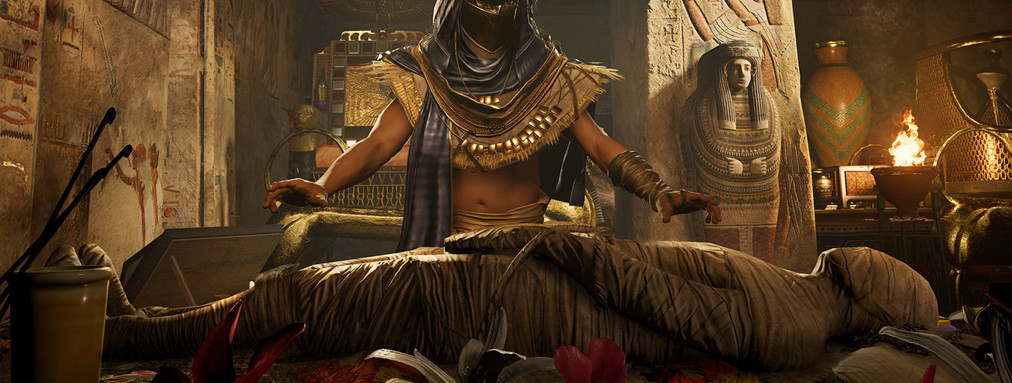
It is in the quest ‘Odour Most Foul’ that we see the most game play associated with embalming. Priests pray to Osiris who does not rot and ‘know corruption’. According to Ancient Egyptian beliefs Osiris was the first to be embalmed by the jackal headed god called Anubis, resulting in Osiris’ resurrection- Anubis was the god of embalmers and are often depicted wearing a jackal headdress (also seen in advertisements for the game). In Origins, Memphis is becoming overpowered by a stench and the player must enter an underground tomb to investigate after speaking to the priests. The underground tomb is filled with bandaged, mummified bodies and canopic jars. Some of the mummies are rotting beneath the wrappings, indicating fault lies with the embalmer as the wrappings are sound. The player must go to the wabet (‘pure place’) and investigate the mummification process, which differs a great deal in size from the small embalmers found in the village in the ‘Birth Right’ quest. The use of the word ‘wabet’ in the game is accurate as this was the place where purification/ mummification took place in the Ptolemaic and Roman Periods. The wabet often had an open court like appearance as seen on this mission. The embalmers are heard praying to the god Anubis and numerous bodies in various stages of preparation are shown in the temple. The gate to the ibu (or ibw) is shown, where the families of the dead bring their bodies. The embalmers wash down the bodies of the dead here, also an accurate use of the term at this stage in the purification process- ibw also mean ‘place of purification’ in this period.

An embalmer with the head of Anubis


The next scene shows an embalmer removing the organs of the dead, an important process in the highest class of burial, and four canopic jars are seen in front of the body- used to hold the main organs of the body. Incredibly, the four jars are the correct anthropomorphic figures, the liver was protected by human-headed Imsety, the lungs by ape-headed Hapy, the stomach by the jackal-headed Duamutef and the intestines by the falcon-headed Qebehseneuf. After the burial, these vassals were placed in the tomb along with mummified deceased body- as seen as the player first investigates the smell coming from the underground chambers.
The next step using natron as a dehydrator is shown, with the embalmer commenting of how it burns his hand. After 70 days the bodies would have been removed and returned to the families for burial- accurately, we see the human shaped, wooden cases the family would have used to transport their loved one to their place of rest. Bayek discovers that the stench from the bodies is due to Natron tainted with sand.

Organ removal with canopic jars at the foot of the bed


Despite embalming being a complicated process in Ancient Egypt, highly dependent on time period and location, Assassins Creed Origins does quite a good job of portraying mummification and the job of embalmers. The important steps in the process are outlined and it is clear that the developers have consulted professionals when depicting the scenes. This was a particularly chaotic period, with the Ptolemaic period coming to an end and the deposition of Cleopatra VII, and beliefs in mummification practices were developed and altered over time. Origins does a very good job at giving the player a picture of life an as ancient embalmer.

Sources consulted

https://oi.uchicago.edu/museum-exhibits/nubia/pan-grave-culture-medjay
https://en.wikipedia.org/wiki/Assassin%27s_Creed_Origins#Synopsis
https://www.metmuseum.org/art/collection/search/548838
Kipfer B.A. (2000) Ww. In: Encyclopedic Dictionary of Archaeology. Springer, Boston, MA
https://www.academia.edu/907351/Ancient_Egyptian_funerary_practices_from_the_first_millenium_BC_to_the_Arab_conquest_of_Egypt_c._1069_BC-642_AD_The_Heritage_of_Egypt_vol._2_no._2_issue_5_May_2009_Cairo_2009_12-28
https://www.academia.edu/271030/In_Preparation_for_Regeneration._The_Wabet_in_Temples_of_the_Ptolemaic_and_Roman_Period
https://www.smithsonianmag.com/smart-news/ancient-egyptians-hunted-then-mummified-crocodiles-180973197/
https://www.ancient.eu/Egyptian_Burial/
https://birminghamegyptology.co.uk/virtual-museum/toward-the-horizon/osiris-the-mythological-origins-of-mummification/
https://www.ancient.eu/article/44/mummification-in-ancient-egypt/
https://www.metmuseum.org/art/collection/search/587568
https://www.youtube.com/watch?v=9kGFbj6iBFY
https://www.youtube.com/watch?v=0iIoPw-SvC0
https://www.game-debate.com/news/23470/assassins-creed-origins-will-have-huge-pyramid-tombs-based-on-real-layouts
https://www.ubisoft.com/en-gb/game/assassins-creed-origins/

The Archaeology of Public Execution in 19th Century Britain: a narrative told through the examination of three accused.

Prior to the Capital Punishment Amendment Act 1868, executions of criminals were public affairs. After the introduction of this act, executions were carried out within the walls of the prison, away from the prying eyes of the general public. In the Victorian era, hanging could attract thousands of spectators- with the events usually advertised prior and reported on in local broadsheets. Prior to 1861 around 222 crimes were considered capital offences until this was rectified by the Criminal Law Consolidation Act. The act meant four crimes were considered a hanging offence, these included murder, arson in a royal dockyard, violent piracy and treason.
The introduction of the ‘long drop’ during this period allowed for a more successful attempt at an instantaneous death. Prior to this strangulation was the only means by which death occurred when hanged. With this new ‘improved method’, the hanged would likely die from dislocated vertebrae or a rupture of the jugular vein. It is likely the accused I discuss below were not on the receiving end of this method, as it was only being introduced into England by William Marwood in the 1870’s after the concept had been developed in Ireland after the autopsy of a hanging at Galway Gaol in 1853.
The examples of the executions I have chosen for this blog post dated prior to 1868 (except for one part of the discussion), before the introduction of the act. From 1874 more measures to ensure quicker methods of hanging were introduced and the accused were treated more humanely. It is through the victims of execution that we get insights into societal attitudes to execution as spectacle, i.e. how they were treated and what remains of them in the archaeological and historical record.

William Burke: Executed in 1829, Edinburgh.
Perhaps the most infamous murderers of the 19th century, Burke and Hare are thought to have killed upwards of 16 people for the price of seven to ten pounds per body. The victims were killed for dissection and paid for by for the well-known anatomy professor, Robert Knox. The duo is most associated with the term ‘body snatchers’ and had a part to play in the introduction of the 1832 Anatomy Act that allowed legal cadaver donation to medical science to stop the illicit cadaver trade. Burke was hanged in front of a crowd of 25,000 and his body was put on public display before being donated to medical science. The famous Professor Alexander Monro tertius carried out the public dissection of Burke’s corpse. This shows that, even after the execution had been carried out, the bodies of criminals were still used as public entertainment. Hare escaped across the border into England after testifying against Burke, and his whereabouts became unknown shortly after that. Anatomy students are thought to have taken Burke’s skin to use as book binding and as other ‘souvenirs’. His death mask and skeleton are still on display in the Surgeons Hall museum Edinburgh and at University of Edinburgh, as well as a pocketbook made from his skin. The keeping of such ‘curiosities’ emphasises the fascination society had, and still has, on criminals of violent crimes. I myself have visited Surgeons Hall museum to view these types of specimens.

Death Mask of Burke
Skeleton of Burke
Skin Pocketbook

Maria Manning: Executed with her husband, Fredrick, in 1849, London.
Maria was born in Switzerland in 1821 and moved to London to work as a maid to Lady Blantyre. Blantyre was a wealthy woman, and the daughter of the Duchess of Sunderland. After having been proposed to by two men- Fredrick Manning and Patrick O Connor- Maria chose to marry Fredrick, a decision she came to regret as O Connor had been the wealthier of the two men. She lured O Connor to her home for dinner, under the pretence she would provide sexual favours, and shot him in the back of the head. The shot did not kill him, with Fredrick finished him off with a crowbar. The murder was motivated by money and jealously, with O Connors body being discovered under the couple’s flagstones by police. Up to 50,000 people are thought to have attended the hangings, with Charles Dickens attending the execution himself. Maria was considered ‘the star of the show’, with her black satin dress she was executed in sold for profit and her death mask was included in Madame Tussaud’s Chamber of Horrors. The Wellcome Trust has the copy of the lithograph entitled ‘The death mask of Maria Manning, the murdered: three views’ by John Lane, created in attempt to assist Tussaud with the likeness. The sexual motivations for the murder and the dominance of the female in the marriage both intrigued and disgusted Victorians. Maria was sensationalised as glamorous, and with the executions of women being particularly rare it’s no wonder her execution caused such an interest. The couple were apparently the first couple to be hanged together since 1700. The broadsheet printed on the execution is held by the British Library, these sheets were cheaply produced and sold on the streets to the masses. It is thought the Manning broadsheet printed around 2.5 million copies.

Death Mask of Manning
The Manning Broadsheet
Lithograph by John Lane

Sarah Lloyd: Executed in 1800, Bury St Edmonds.
Sarah Lloyd was no more than 22 years of age when she was executed. Her story is tragic and emphasises the importance put upon obedience in female servants at the time. An illiterate servant, Sarah was enlisted by a man called Joseph Clarke to steal from her mistress, after which he attempted to set the house on fire. Clarke never admitted to any crime, and the judge decided Sarah would be made an example of. He sentenced her to death despite numerous outcries. The local Rev Drummond petitioned for Sarah as he recognised her as a ‘helpless instrument’ who had fallen under Clarke’s spell. Clarke did not receive any punishment for his crimes. Sarah was executed in front of a weeping crowd on the 23rd April 1800, she highlighted the type of person that was the most likely to be executed – a person of lower class and with little education (Sarah wasn’t even sure of her own age, she may have been only 19 years old when executed). Her gravestone states ‘May my example be a warning to thousands’- her reported last words as she stood on the gallows. Archaeologically, this seems to be all that remains of her execution, perhaps echoing how unimportant she was deemed in society. The last woman to be hanged in Britain was Ruth Ellis, who was executed in 1955. Like Lloyd, there was a large public outcry when Ellis was sentenced. She was a mother of two who had shot an abusive partner, David Blakely, thought to have induced a miscarriage shortly before the murder. Ellis had been to hospital multiple times for treatment of injuries inflicted by Blakely. Another woman by the name of Sarah Lloyd had murdered her elderly neighbour in 1955 by hitting her with a shovel and pouring boiling water on her- she had been sentenced to death but did not hang, even though no one petitioned for her. Ellis was not given the same treatment. As with the 1800 case of Sarah Lloyd, Ruth Ellis was not given any leniency because of her background – she was thought to provide sexual favours for men and liked to drink. Both hangings caused public outrage (though Ellis committed premeditated murder), even though they were over 150 years apart. Although Ellis does not fit with the 19th century timeline (her execution was carried out privately), her execution is a good example of how the public narrative was similar in much earlier cases towards certain accused.

Grave Stone of Lloyd
Ruth Ellis and David Blakely
Newspaper Article on Ellis

Public execution: entertainment for the masses, or a warning to others?
Archaeological material associated with victims of public execution in 19th century Britain can be interpreted in several ways. The material, whether that was the body itself or newspaper clippings etc., show that the public reaction towards the gruesome spectacle was very much based on the crime committed and the person who committed them. Hangings weren’t all we assume they were- a crowd of the poor population shouting obscenities at the accused. As with the case of Sarah Lloyd, the public did not want her hanged, and often the educated, more wealthier classes would also attend the hangings. The input of mathematicians and medical doctors in developing the more humane long drop method in the second half of the 19th century also comments on the changing attitudes towards the accused. The suffered during and prior to the execution became a concern where it hadn’t before – perhaps due to outcries from the general public and medical community alike? The keeping of ‘mementos’ from the hanged (particularly in the case of Burke) also highlights the celebrity status that could accompany the criminals. The fascination we still have with these artefacts can only comment on our own fascination with these executions- but the important question to ask is do we view them as victims or simply as criminals?

Sources
http://vcp.e2bn.org/justice/page11359-types-of-punishment-hanging.html
http://www.legislation.gov.uk/ukpga/Vict/31-32/24
http://www.bl.uk/learning/histcitizen/victorians/crime/broadsides/hangings.html
https://www.historic-uk.com/HistoryUK/HistoryofScotland/Burke-Hare-infamous-murderers-graverobbers/
https://museum.rcsed.ac.uk/the-collection/key-collections/key-object-page?objID=1225&page=2
https://www.ed.ac.uk/biomedical-sciences/anatomy/anatomical-museum/collection/people/burke
https://www.capitalpunishmentuk.org/mannings.html
https://www.bl.uk/collection-items/a-broadside-on-the-execution-of-the-mannings
http://oldoperatingtheatre.com/blog/there-together-be-suspended
https://wellcomecollection.org/works/jjfvanve
https://www.europeana.eu/en/item/9200579/nm2chxqu
Moore, J., (2018) Murder by Numbers: Fascinating Figures Behind the Worlds Worst Crimes. The History Press: UK.
https://www.historic-uk.com/HistoryUK/HistoryofBritain/The-Art-of-Hanging/
https://www.naomiclifford.com/sarah-lloyd/
Ballinger, A., (2019) Dead Woman Walking: Executed Women in England and Wales, 1900-55. Routledge.
http://www.capitalpunishmentuk.org/child.html
https://www.flickr.com/photos/brizzlebornandbred/6314035695
http://www.rowdiva.com/Lloyd.html
http://www.britishexecutions.co.uk/execution-content.php?key=2265&termRef=Sarah%20Lloyd
http://www.capitalpunishmentuk.org/lloyd.html
https://www.pressreader.com/uk/bbc-history-magazine/20180125/281651075515787
https://www.irishtimes.com/culture/art-and-design/visual-art/ruth-ellis-the-model-who-smiled-at-her-executioner-1.3690704
http://www.capitalpunishmentuk.org/longdrop.html
https://www.mirror.co.uk/news/real-life-stories/ruth-ellis-last-woman-britain-12176921

The Archaeology of Victorian Grief: Looking at how the 19th Century mourned their dead and how it has shaped today’s practices.

Grief is a personal experience, but it can be largely influenced by societal norms, cultural background and it is very much a product of the era in which the death occurred. Grieving practices in one society can seem completely alien to another- I myself have experienced this in the UK when I discuss rural, Irish, Catholic death and grieving practices with friends and colleagues. It seems incomprehensible to many I spoke with that we would have our deceased loved one in our family home as part of the mourning associated with an Irish wake, just as it seems alien to me that their loved one would stay in the funeral home, often for weeks, before the funeral.
Even before I started training with an embalmer, I was always comfortable in seeing a dead body as the first time I saw one was when I was eight years old. It was my grandfather, and he was ‘waked’ traditionally at home. Since then, I have seen the deceased body of numerous loved ones- including both of my parents who died young, cousins, aunts, uncles and grandparents. Although the sadness at each of their wakes was profound, it should be said that these wakes assisted in the grieving process. With sadness, there also came laughing about good times, reminiscing and family bonding. Wakes weren’t all a bad experience, and I can totally understand why someone who isn’t used to such grieving practices would find that confusing. This is something we should bear in mind as I discuss Victorian grieving. What may seem odd and confusing by today’s standards, was probably a source of comfort for those who mourned in that era. To discuss Victorian death and grieving practices I have selected four archaeological items I feel best illustrate a narrative of the 19th century for the reader. It has been suggested that the almost obsessive nature of grieving in this period was partly fuelled by Queen Victoria and her mourning for her husband Prince Albert. Victorians became obsessed with the etiquette associated with mourning and would spend a great deal of money on giving their loved one a ‘good death’. Death was frequent in society, and there was always an open conversation about arrangements and practices (by today’s standards we would probably call this a ‘morbid fascination’)- some women even included their own shrouds to wear when they passed away in their wedding dowry. The intricacies of Victorian grief and mourning could be discussed for hours on end with hundreds of objects at our disposal, but below are the objects I have chosen for this blog post for a snapshot into Victorian grief.

  1. Death Photography, often referred to as ‘Memento Mori’
    Artefact: 19th Century image of a little girl with her deceased sister.

With the emergence of photography as an everyday practice in the 19th century, it is no wonder the emerging Victorian middle class adapted the practice in their grieving. Photography was a quicker and cheaper option than portrait painting, thanks to the introduction of daguerreotype images in the 1830s. The examples of the images of this type from the time are all posed and well-staged. Some of the images show the living loved ones slightly blurred from movement during exposure, whilst their deceased love one is shown with a crisper image. Children were particularly used as subjects, as the mortality rate was so high, with families often wanting to capture all their family before burial. Children often posed with their dead siblings, as we can see from the example seen below of two young sisters. This would seem an awful thing to ask of a child to do today, to pose with their dead sibling- but children of the time were well acquainted with death and grew up with it. BBC news wrote an article on the topic of Victorian death photography- calling it upsetting, but how are/ were these images upsetting? Are they upsetting us as we view death today? These images certainly didn’t upset the people who took them, on the contrary- they helped them mourn healthily by their own standards.

A little girl with her deceased sister
  1. Mourning Jewellery, also referred to as ‘Memento Mori’
    Artefact: Mourning onyx earrings with blond hair, c. 1860-70.

Mourning jewellery was particularly popular amongst Victorian women, with hair often used in ornaments such as lockets. However, within the first year of ‘deep mourning’, no ornaments were to be worn except for dark stones such as jet or onyx. Photographs as well as the hair of a loved one was often worn around the neck, something which many people still do today (myself included, I have a gold locket with an image of my mother and a small piece of her hair). These ornaments became a strong part of Victorian grieving traditions, and many examples can still be found in museums and antique stores. They are often collected by private collectors today, continuing the trend of ‘morbid fascination’. There are even examples of mourning jewellery made from glass eyes and teeth. Many also were inscribed with Latin inscriptions and images of skeletons.

Onyx mourning jewellery
  1. Death Masks
    Artefact: 19th Century death masks from University College London.

Death masks were plaster casts made of the deceased face upon their death. Many casts were made of loved ones for families to keep after their burial- however, many were taken of criminals and the executed, used for studies such as that of emerging phrenology at the time. Death masks were often displayed in the home, with Queen Victoria having had a bust made of Prince Albert that was displayed in many of the family photographs after his death. Instead of a photograph, death masks were more of a 3D remembrance of a loved one – the mask was usually cast very soon after death so that post-mortem bloating did not compromise accuracy. The cast was usually filled with wax or metal to create the finished likeness. A grease of some sort was applied to the face before plaster bandages were used to prevent facial hair from sticking to the mixture. The examples shown below are from University College London, whilst some of them are criminals some of them are loved ones requested to be set in plaster by their family – we even see an example of a child. The child is thought to be a young musical genius and was chosen for phrenology as to try and map his traits and personality.

UCL death masks
  1. Black Clothing
    Artefact: Photograph of the five daughters of Prince Albert in mourning dress, 1861.

Today the practice of wearing black for funerals is still widespread in western grieving traditions- usually just at the funeral of a loved one. However, in the Victorian era, this was practiced in the first year after death but often extended to two- two and a half years after death. In the case of Queen Victoria, she wore black clothing in the forty years after her husband’s death until her own death in 1901- explaining why the tradition became stricter in the second half of the 19th century. Most photographs we see of the queen in the historical record show her dressed heavily in black and dark colours such as purple or grey. Women, especially widows, were expected to wear the heavy black dress and veil, also referred to as widow’s weeds. Those who couldn’t afford new mourning clothing usually dyed old garments black, with even jewellery and buttons strictly meant to be black as well. Usually the amount of black worn was lessened as time went on (the amount of time depended on the relationship with the deceased). However, in a time where death was so commonplace it was often that women spent years in black attire, as one mourning period ran into the next. The only exception to wearing black attire was when the death of a young girl occurred. Many people would wear white in the form of silk ribbons, hat bands or hoods to represent the purity of the deceased girl.
This was the only exception however, with black the most commonplace colour. Most mourning images of the time show ladies in black dress, many often have their faces concealed with a long black veil called a ‘weeping veil’. These veils were usually made of a silk fabric called crape, and often the dye could cause skin irritations and other health problems.

Prince Albert and Queen Victoria’s five daughters in mourning clothing

Have Victorian customs shaped our grieving today?
It is fair to say that the Victorians were comfortable with the prospect of their own death or the death of a loved one. Their regimented grieving practices show a society comfortable with losing loved ones, with daily lives focused around death and its inevitability. As emphasised in the archaeological material, Victorian society were strict in their grieving and were not afraid to show aspects of their bereavement. One can question how ‘healthy’ an approach this is, but it should be said that this illustrates a variety in the way society grieved that was deemed appropriate. Echoes of the era survive today in the way we say goodbye to loved ones. Black is still worn in Western Christian funerals, open coffins are common, as is types of mourning jewellery. What we deemed strange in past and a ‘morbid curiosity’ has in fact diluted down to our present- and remains the bones of how we grieve in society today.


Sources
https://www.ranker.com/list/victorian-mourning-customs/lisa-waugh
https://www.psychologytoday.com/gb/blog/understanding-grief/201812/death-and-mourning-practices-in-the-victorian-age
http://www.angelpig.net/victorian/mourning.html
https://theconversation.com/memento-mori-remember-that-you-have-to-die-42823
https://www.bbc.co.uk/news/uk-england-36389581
https://www.nationaljeweler.com/independents/2058-the-history-behind-victorian-mourning-jewelry
https://victorianmonsters.wordpress.com/victorian-funerary-practices/
https://io9.gizmodo.com/love-after-death-the-beautiful-macabre-world-of-mourn-1498829544
https://www.tchevalier.com/fallingangels/bckgrnd/mourning/
https://www.buzzfeed.com/hayleycampbell/death-masks-and-skull-amnesty
https://missmementomori.wordpress.com/tag/death-mask/
https://avintagevault.wordpress.com/tag/victorian-death-masks/
https://www.historicmysteries.com/death-masks/
https://edition.cnn.com/style/article/death-masks/index.html
https://www.thevintagenews.com/2018/09/16/mourning-fashion/
http://www.katetattersall.com/mourning-dress-victorian/
https://www.racked.com/2018/3/29/17156818/19th-century-mourning-veil

The Archaeology of Epidemics: Disease, Death and Dying.

Amid the current Covid-19 pandemic, it is more important than ever to talk about death and disease in a manner that is sensitive yet pragmatic. A way to understand the development of public health is to look to the past through archaeological material. However, dismissing the current pandemic as being ‘not as bad as the past’, can be a problematic approach. Yes, the 14th century Black Death killed 200 million people, but that doesn’t lessen the severity of our current health climate. On the other hand, we cannot directly compare the two, as to do so only creates an atmosphere of mass panic and hysteria. Comparing Covid-19 to a pandemic in a time of poor sanitation with little known effective medicines is dangerous and irresponsible. Both approaches have their dangers- so what should we do?

We should approach historical and archaeological material with both approaches in mind as to make sensible observations. For example, the British Society for the History of Medicine (BSHM) recently posted an article entitled ‘Can history help us in the Covid-19 epidemic?’ asking whether global health management of today can learn anything by examining the handling of the 1918 Spanish Flu pandemic. Whilst comparisons are made between both pandemics (i.e. lack of vaccine, slow implementation of social distancing), it is clear that the research of mortality rates of Spanish Flu were done to encourage quick intervention, not as a way to create panic amongst the general public. Epidemiologists are approached more and more on contributing to global health management, a responsibility with a lot of strings attached.

This post will look at four examples of archaeological material from four different pandemics/ epidemics (most were originally epidemics that became pandemics) with the hope of encouraging discussion on disease mortality without directly comparing them with Covid-19. Discussion of current public health concerns through observing archaeological material is important but should be done with an objective mind in assessing how relevant they are today.

  1. Bubonic Plague- ‘The Black Death’ (1346-53)
    Death toll: 50 million worldwide
    Mass burial ‘Plague Pit’, East Smithfield, London (1348).
    Everyone has heard of the ‘Black Death’, the catastrophic tragedy that killed 60% of Europe’s population. The bubonic plague outbreak was linked to the bacterium Yersinia pestis (though recently this has been challenged) that spread through wild rodents. With rat infestation such a problem in the past its no wonder the disease spread with such ferocity. Once fleas killed off the rat colonies they would turn to humans as new hosts. Bubo sites would often form in groin, thigh, armpit or neck (Lymph node sites) and the bacteria could spread through the blood stream to the lungs causing cases of pneumonic plague. This was only in a small number of plague cases, but the bubonic infection would kill 80% of victims. Often symptoms would only develop 5 days after infection, and another 3-5 days after the victim would die.
    In 1986 archaeologists discovered a large cemetery near the Tower of London in East Smithfield. The burial ground was confirmed to be an emergency cemetery to cope with the rising death toll, and over 24,000 people are thought to be buried at the site. Plague pits were all over Europe to dispose of victims of bubonic plague. These mass, anonymous graves can be viewed as pragmatic response to death- but what were the effects on the bereaved? Although the outbreak occurred at a time when mortality rate was high anyway, one cannot help but ponder how the population felt about their loved one buried or ‘stacked’ without the pomp associated with religious rites. The use of mass graves has been linked to infectious disease as a way to stop the spread of an epidemic- in this case however it was likely to confine the ‘smell’ which was more associated with sickness then the disease itself (i.e. Miasma Theory). Some probably went into the pits without identification, another worry for families in a time of desperation.
The East Smithfield plague cemetery
  1. Bubonic Plague (last wave in Britain)- ‘The Great Plague’ of London (1665-1666)
    Death Toll: 100,000 in London
    17th Century plague doctor mask
    The plague outbreak of 1665, was the worst outbreak of the disease since it’s 14th century outbreak. It was the summer months that caused the outbreak to swell, with many of the wealthier classes fleeing the city. Much of the poor had to stay in London to prevent the spread of infection to other parts of England – all trade was halted from the city and Scotland even closed its border with England. Infected houses were watched over and the dead were searched for at night and buried in plague pits in the same manner as the 14th century outbreak. This era of the epidemic resulted in the further rise of plague doctors. Perhaps the most iconic image of this era is the plague doctor mask. This beak-like mask was used to protect the wearer against bad smells and prevent contagion, with a wooden cane used to probe victims to stop themselves touching the infected buboes. The nose of the masks was filled with substances such as cloves, rose petals and other pleasant-smelling herbs. Charles de L’Orne is credited with creating the iconic costume in 1619, it was usually made from goat leather. Although we still see the association with disease and miasma theory, it is clear the population were becoming more conscious of the isolation of the infected. Plague doctors also carried out autopsies on the dead and listed deaths on the public register. Treatment often included blood letting and the use of leeches.
16th century German example of the ‘plague mask’
  1. Broad Street Cholera Outbreak, London (1854)
    Death Toll: 500 in 10 days on Broad Street, London
    The Broad Street (now Broadwick Street) Pump
    There were numerous outbreaks of cholera in London in the 19th century. The worst outbreak killed almost 15,000 people in 1849. Whilst cholera was a worldwide pandemic, the Broad Street outbreak is significant as we look at the investigatory work of Dr John Snow. Cholera effects the intestines and can cause death at quite a rapid pace, the first symptoms are vomiting and diarrhoea. According to the World Health Organisation, cholera still kills 100,000 people annually.
    Miasma theory (Illness from bad air/smells) was still a prevalent theory surrounding disease outbreaks, until Snow was able to prove that this epidemic was a result of contaminated water. Snow studied the patterns of death and plotted their locations on a map, allowing him to conclude that water was the source of the outbreak. The Broad Street pump was very close to a cesspool and Snow removed the handle from the pump himself after community officials ignored his pleas to intervene. Although the original pump is no longer at the site, a replica one was placed there in the summer of 2018.
Replica of the Broad Street pump- based on original archaeological example
  1. Influenza Pandemic (‘Spanish Flu’), H1N1 (1918)
    Death Toll: 50 million worldwide
    Spanish flu face masks
    Perhaps one of the deadliest pandemics of recent history, Spanish flu spread between 1918 and 1920. It is estimated that half a billion people were infected with the virus – this was about one third of the world’s population at the time. The mix of urbanisation without any known vaccine or antibiotics to prevent secondary infection, meant the virus was particularly lethal. There was quite a high mortality rate amongst the younger population, with those between the ages of 20 and 40 considered one of the most vulnerable groups, as well as those under the age of 5 and over the age of 65.
    Health initiatives of the time became strict and limiting, with quarantining and social isolation becoming the norm. Images of the time are striking in their similarities to modern populations, as face masks become more of a fashion statement than sanitary necessity. Face masks worn by women of the time could stretch down like a veil – echoing the ‘trendy’ masks we see now. Hand washing and personal hygiene also became the prime advice given by health professionals. Perhaps it is the similarities in societal anxieties and healthcare advice that allows us to make links with outbreaks of the past, not similarities in the nature of the disease itself.
Veiled Spanish Flu masks

Sources
Antoine D. (2008). The archaeology of “plague”. Medical history. Supplement, (27), 101–114.https://www.mentalfloss.com/article/505090/doctors-didnt-actually-wear-beaked-masks-during-black-plague https://allthatsinteresting.com/plague-doctors
https://www.cdc.gov/flu/pandemic-resources/1918-pandemic-h1n1.html
https://www.nationalarchives.gov.uk/education/resources/great-plague/
https://plaguedoctormasks.com/history/
https://www.atlasobscura.com/places/broad-street-cholera-pump
https://www.ph.ucla.edu/epi/snow/snowcricketarticle.html
https://www.who.int/news-room/fact-sheets/detail/cholera
https://www.abc.net.au/news/2020-03-04/spanish-flu-pandemic-provides-insights-into-coronavirus/12020570
https://wellcomecollection.org/works?query=%22Plague%20doctor%2013
https://9gag.com/gag/an9EwAB/real-16th-century-plague-doctor-mask-supposedly-back-then-it-was-thought-that-the-plague-was-more-or-less-caused-by-bad-smell-and-the-beak-was-for-storing-things-that-emitted-a-pleasant-aroma
https://www.historyanswers.co.uk/medieval-renaissance/why-did-doctors-during-the-black-death-wear-beak-masks/
https://www.newscientist.com/article/dn12393-black-death-casts-a-genetic-shadow-over-england/
https://www.historytoday.com/archive/black-death-greatest-catastrophe-ever
https://bshm.org.uk/can-history-help-us-in-the-covid-19-epidemic/
https://designyoutrust.com/2020/02/an-authentic-16th-century-plague-doctor-mask-preserved-and-on-display-at-the-german-museum-of-medical-history/

Embalming Fluid in Archaeology: What Did We Use to Preserve our Dead? The Discussion of Four Bodies

Embalming fluid is found throughout archaeological contexts and in historical accounts, even Jesus Christ himself was ‘embalmed’ according to the Bible. His body was washed and perfumed with organic compounds, possibly myrrh and aloe, and placed in his tomb before his resurrection. Despite this process of intended preservation, it is more likely the body was perfumed for pomp as there is no mention of body cavity preservation or organ removal. Although we do not have any archaeological evidence in the case of Christ, the mentioning of his embalming is significant as it is not mentioned for all biblical figures. The preservation of his body coincides with his resurrection, a possible link to the rise of embalming in numerous historical societies that embraced religious culture. What adds more to the significance of the embalming ingredients of Christ is the fact myrrh, a resin, was brought by Balthazar to the stable in the Nativity story. To understand the complexity of intended body preservation ingredients in archaeology, I have selected four bodies to discuss the development of embalming fluid recipes.

  1. ‘Balm’ Origins – The Turin S.293 Mummy, Egypt, c. 3700BC.

Gas chromatography mass spectrometry (GC-MS) analysis indicated evidence of a ‘balm’ recipe which impregnated the textile wrappings found around the body of the Turin Mummy. The recipe was found to consist of a base of plant oil (the bulk of the balm), with conifer resin, an aromatic balsam and plant sugar. There was also evidence that suggested the mixture of resin had been slightly heated in the process. Despite the early date of the mummy, embalming fluid mixtures were already being established, with similar antibacterial agents (i.e. Resin) seen with Egyptian embalmers at the peak of the dynasty thousands of years later. Interestingly, this find suggested embalming was used over a thousand years earlier than we first thought. Like later mummies, the Turin mummy was dried out in salts with the organs removed before the balm was smothered over the remains. The removal of the organs and the antibacterial nature of the natural resin/ extracts halted microbial growth and thus allow for excellent preservation. The oils and resins applied to the body ‘sealed’ it from moisture in the air, however some fungi have been inhaled upon disturbance of mummified remains (i.e. pathogens and king Tutankhamun’s curse have been linked).

  1. Apothecaries’ Powders – King Henry VIII, England, 1547.

After the death of the famous Tudor monarch, the body was embalmed using the Tudor era recipe. The apothecary, Thomas Alsop, supplied the materials needed for his embalming process. This included cloves, various balms, oils, tox, myrrh, nigella and musk which likely cost the equivalent of more than £6,000 today. It is clear the Egyptian recipe still had influence thousands of years later, with the use of oils, scented balsams and powders used for dehydration of the corpse and protection against moist air. As with the use of bandages in mummification, Tudor corpses were wrapped in waxed cloth to further protect the soft tissue. Organs were removed often, and the body cavity was often flushed with the embalming fluid, much like the use of a trocar today. The use of a fatty oils along with resins and pleasant-smelling herbs/ spices made up most embalming fluid in different eras up to this point. The ancient recipe proved to be a worthy formula for future embalmers, with only some modifications made to account for the geographical location of natural derived ingredients and some modern updates. Sir Henry Halford recorded the exhumation of Charles I in 1813 and remarked upon the remarkable fresh appearance of his body (he died in 1648) and that was wrapped in cloth with a resin material within a lead coffin. Although the coffin of Henry the VIII stood in the same vault, the identity of his corpse was not in dispute like that of Charles’s, so it remained unopened by Halford. Halford does however remark upon the condition of the coffin which had been damaged and exposed his intact beard, but his torso showed skeletal remains, likely skeletonised from the disturbance of the lead coffin.
Descriptions of the 16th Century embalming method are mentioned by writers such as Forestus (1522-1597) and Paré (1510-1590). Both mention similar ingredients to Alsop’s materials for an aromatic powder to be inserted into body incisions (much like modern injecting) and a washing solution comprising of aqua vita and vinegar. It was around the 16th Century that anatomists such as Da Vinci (and even earlier in the case of Alessandro Giliani) started experimenting with injecting the fluid into the body. Often the fluid consisted of a wax like substance that would dry and reveal inner systems to those who studied anatomy.

  1. Arsenic and Arteries – President Abraham Lincoln, Washington D.C., 1865.

With the rise of the body count during the American Civil War came the rise of the embalming method amongst grieving families. Lincoln had his son Willie embalmed when he died in childhood from fever (the same embalmer embalmed Lincoln himself), even having him exhumed twice to see him again. Lincoln was an avid supporter of the practice and was embalmed so he could lie in state over numerous locations over a few weeks (strangely, his embalmed son was exhumed and moved with him on the ‘funeral train’ journey to be buried alongside his father). It is reported in historical documentation that Lincolns embalming process ‘held up’ on the first few stops of his final journey, with his features becoming more ‘shrunken and dark’ when they reached New York. It was the Presidents famous embalming that led the way for the practice to become the norm in modern American society. The method of arterial embalming replaced the ancient method. It was developed by the chemist Jean Gannal in the 1830’s, who initially worked an apothecary’s assistant where he no doubt became well versed in understanding various embalming fluid ingredients. The fluid used in this era was highly toxic. Arsenic and mercury were used (Cuvier is reported to have used pure alcohol), and many embalmers are thought to have died from poisoning. The toxicity of embalming fluid becomes more apparent around this time before the introduction of the ‘safer’ formaldehyde-based mixture which becomes commonplace in the 20th century.

  1. Formalin as fixative – Rosalia Lombardo, Palermo, 1920.

Alexander Butlerov (1828-1866) and Wilhelm von Hofmann (1919-1892) were the ones to discover formaldehyde (gas). Even though embalming fell out of favour for a few years following the Civil War, it is around 1896 when formaldehyde is introduced as a method of embalming. Colour preserving formulas were introduced in the 1920’s. Body preservation became concerned with restoring the natural colouring of the skin to allow for a more life like appearance. One unusual example in archaeology is the case of Rosalia Lombardo. Rosalia died in Italy in 1920 from pneumonia at the age of 2. Her father sought the help of a local embalmer/ taxidermist called Alfredo Salafia to carry out her preservation. What is interesting to note is that Salafia was a successor of Trachina (1797-1837), a famous anatomist who used arsenic for arterial embalming. For this reason, it was thought for a long time that Rosalia had been embalmed using arsenic. She is now on display in the Capuchin Catacombs in remarkable condition. The recipe for the fluid used has since been found, it consisted of formalin (to stall decomposition- formaldehyde and water), glycerin (stops desiccation), zinc salts (stopped her features collapsing), alcohol and salicylic acid (stops the growth of mould). CT scans of her body shows all her organs perfectly intact and she has quickly become an iconic archaeological specimen that also emotes empathy for childhood mortality. Today, in simplistic terms, the ingredients used to make up embalming fluid usually consist of formalin (preservative), phenol (antibacterial), methylated spirits (fixative), glycerin (pliability and hydration) and water (decrease acidity), showing some remarkable similarities to ingredients used 100 years ago. Embalming fluid is also used to restore the pigmentation of the skin, with the fluid often tinged pink and used with tissue builders. I have assisted and watched the process and it is remarkable to see the pink colour appearing on the skin and the ‘plumping up’ of the features, particularly in the case of a heavily emaciated person.

Whatever ingredients went into the development of embalming fluid in the archaeological record, they all served a purpose- whether that purpose was ceremonial, antibacterial or as a means of preservation. Ingredients in the fluid and exact quantities are more important now than ever, and with the introduction of new methods such as Thiel embalming and plastination, it is clear the development of what we use to preserve our deceased is still on going.

Sources consulted

Batra, A.P.S., Khurana, B.S., Mahajan, A. and Kaur, N., 2010. Embalming and other methods of dead body preservation. International journal of medical toxicology & legal medicine, 12(3), pp.15-19.

Brenner E. Human body preservation – old and new techniques. J Anat. 2014;224(3):316–344. doi:10.1111/joa.12160

Dixit, D., Athavia, P.D. and Pathak, H.M., 2005. Toxic effects of embalming fluid on medical students and professionals. JIAFM, 27(4), pp.209-11.

Gannal, J. (Jean-Nicolas)., Harlan, R. (1840). History of embalming: and of preparations in anatomy, pathology, and natural history; including an account of a new process for embalming. Philadelphia: J. Dobson.

Halford H, Essays and Orations, 1831, London John Murray.

Jones, J., Higham, T.F., Chivall, D., Bianucci, R., Kay, G.L., Pallen, M.J., Oldfield, R., Ugliano, F. and Buckley, S.A., 2018. A prehistoric Egyptian mummy: Evidence for an ‘embalming recipe’and the evolution of early formative funerary treatments. Journal of Archaeological Science, 100, pp.191-200.

https://www.stuff.co.nz/travel/news/114150522/ten-of-the-worlds-famous-embalmed-dead-bodies-on-display

https://www.nationalgeographic.com/magazine/2009/02/sicily-crypts/

Death’s Doll: The World’s Most Beautiful Mummy

https://www.smithsonianmag.com/science-nature/how-lincolns-embrace-embalming-birthed-american-funeral-industry-180967038/

http://theconversation.com/how-lincolns-embrace-of-embalming-birthed-the-american-funeral-industry-86196#:~:targetText=Upon%20the%20death%20of%20Lincoln’s,resting%20place%20in%20Springfield%2C%20Illinois.

https://pastnow.wordpress.com/2013/04/01/april-1-1813-charles-i-found/

From Archaeology to Autopsy: Five Fantastic Books about Death.

For those interested in all thing’s death related and want to explore the topic further, whether that be funerary archaeology or modern dissection techniques, it can be hard to know which books to start with. The complexity of death as viewed by modern society and the intricacies associated with the treatment of the dead in the past have been a hot topic of many authors, with some focusing on one aspect more than another depending on their professional background and interests. Death is a vast topic with so many branches in different academic fields, and it is difficult to locate a ‘one size fits all’ narrative. So, I have selected five books that discuss numerous death related topics- from cadaver related research to osteology- all these books have something for everyone and are excellently written.

  1. Smoke Gets in Your Eyes: And Other Lessons from the Crematory by Caitlin Doughty.
    Caitlin Doughty is quite well known in the funeral industry. Born in Hawaii, Doughty started her career in the death industry as a crematory assistant at Westwind Cremation in San Francisco before attending mortuary school. Her first book, Smoke Gets in Your Eyes (later she wrote From Here to Eternity which is worth a read if you are interested in world cultures and death) documents her personal encounters with death in a manner that is humorous as well as professional. The book focuses mainly on her time spent at Westwind and her early interactions with corpses and grieving families. Heart-breaking and heart-warming, Doughty tells tales about her time spent processing cremated remains, assisting the embalmer, picking up corpses and her general duties surrounding her handling of the dead. She is a huge advocate for ‘death positive’ attitudes having set up the organisation The Order of the Good Death which promotes natural burial and tries to decrease the real anxieties we all have about dying. She encourages her readers to talk about death openly with their loved ones to eliminate fear surrounding the subject. This is a must read for anyone interested in the funeral industry of today and what the job entails at crematoriums and funeral homes alike.
  1. Past Mortems: Life and Death Behind Mortuary Doors by Carla Valentine.
    Carla Valentine is the current technical curator of the St Bart’s pathology museum in London and has worked for years as an anatomical pathology technologist. She also studied Forensic Anthropology and Archaeology, having taken part in plague grave excavations and WW1 grave excavations. Valentine has the best of both worlds, with an interest in both pathology and specimens of the past. Her book, Past Mortems, is great for those interested in modern anatomy and autopsies. Valentine discusses decomposition, dissection and death in detail in a way that is both personal and factual. Like Doughty, Valentine encourages discussions about death and encourages positive attitudes when talking about mortality. Her compassion for the bereaved is also evident, particularly when she discusses helping identify the victims of the 2005 London bombings. This book is a must read for those with a fascination for pathology and mortuary practice.
  1. All That Remains: A Life in Death by Dame Professor Sue Black.
    For those interested in the field of forensic anthropology and bioarchaeology, the name, Sue Black, will be particularly well known. Sue Black was Professor of Anatomy and Forensic Anthropology at the University of Dundee between 2005 and 2018, where she was head of the Centre for Anatomy and Human Identification at the University of Dundee (CAHID). Prof Black has also assisted police in criminal investigations and has authored/ co- authored numerous academic publications, as well as starred on BBC Two’s History Cold Case. All That Remains allows Black to discuss her remarkable career as a forensic anthropologist. She talks about human remains from numerous contexts, including archaeological burials, crimes, war zones and labs. Pairing these accounts with her personal encounters with death growing up in a strict, Scottish, Presbyterian family, Prof Black manages to fully engage with the reader and allow them to learn something from beginning to end. This book should be required reading for those studying forensic anthropology or other similar fields.
  1. The American Way of Death by Jessica Mitford.
    Funeral industry fanatics will have heard of Jessica Mitford. Born into an aristocratic English family, Mitford’s political ideologies were extreme in comparison to her upbringing. She placed herself firmly in the far-left wing of politics and joined the American Communist Party with her second husband, whom she also worked closely with as a civil rights activist. Having joined the Communist Party during the era of McCarthyism, Mitford was a woman who was not afraid to speak her mind. Her book The American Way of Death is a social commentary on the American funeral home industry. Now a Classic, the book researched the commercialised aspect of death in 1960’s America and the expense of sentimentality for grieving American families. Mitford strongly criticised the industry and accuses funeral directors of taking advantage of families at difficult times in their lives, with added expenses for funerals seen as unnecessary and extortionate. Even the updated version from the late 1990’s still seems shocking and critical today. This book is a classic on social attitudes towards death and funerals and is well worth a read whether you agree with Mitford’s criticisms or not.
  1. Stiff: The Curious Lives of Cadavers by Mary Roach.
    Mary Roach did a fantastic Ted Talk a few years back entitled 10 things you didn’t know about orgasm. It’s clear from this talk that Roach has a fantastic, humorous way of storytelling. Her first book Stiff dates to 2003 but still seems relevant today. The book discusses Roach’s encounters with cadavers and a history of how cadavers have contributed to scientific research. The topics of the book range from body snatching, to body farms, to crash test cadavers. All together she has published seven books, but Stiff is the book for those with an interest in anatomy, forensics and death history. Stiff also discusses the ethical issues raised in using cadavers for experimentation, with Roach questioning whether family members truly understand what their loved one has left their remains. Like the other authors in this list, Roach still manages to find a healthy balance of humour, science and compassion in her writing style.

The archaeology of embalming in four objects: an overview of intended preservation practices.

The grisly art of embalming has a very long history attached to it. This intended method of body preservation has varied immensely in numerous cultures over different time periods, however the aim of all these methods has been the same– to stall decomposition. Whether stalling decomposition was for the upkeep of public health and sanitation standards, for allowing the body to be presented to the family members or the public, or simply as part of a religious custom, it is what is left behind in archaeological deposits that allows us to begin to understand this practice. Modern embalming practices using formaldehyde solutions are common throughout the Western World, with some authors such as Mitford and Doughty questioning the need for this added expense on families by funeral homes. To understand the origins of this science and why it is still prevalent today, I have chosen four objects from the archaeological record to best demonstrate the complexity of embalming in past societies.

1.Origins: c.1300BC, Egypt- The Embalming Cache from Tutankhamun’s tomb.     

One of the most famous archaeological finds in recent times also contained evidence of the earliest embalming practices. Although Egypt may not have been the very first civilisation to preserve their dead, they are by far one of the most famous. Amongst the finds with Tutankhamun’s mummy were the remains of an embalming cache. Included in the pit were jars with bags of natron, mud seals, bandages, kerchiefs and inscribed linen. Natron naturally occurred in the Nile Delta and was used in the embalming process in Egyptian society. Much like a modern embalming practice, the body was washed, and the organs were removed (this is also the case for modern embalmers who must treat an individual who has had an autopsy). Natron and other naturally occurring salts were used for desiccation of the body over several weeks. It is likely the body cavity was also stuffed with these salts as well. The body was then treated using oils, perfumes and herbs (most likely antibacterial like the ethanol used in modern embalming). Wrapping of the body with bandages then began, a timely process which warped body shape and finished the process before entombment. Within the Pharaoh’s tomb were also three headscarves thought to have been worn by the embalmers, one of which was died blue. As with the lab coats/ scrubs of many modern embalmers, these headpieces were likely used as a sign of respect or for sanitation. Even in the ancient world, the job of embalmer was respected as these used, well-worn kerchiefs (some sewed and darned) were buried with their king. As part of the embalming cache were long reeds that may have been used in probing the body. The sharpened, burnt ends suggest to archaeologists that heat was used as part of a sterilizing effect. However, the kit of a modern embalmer contains a trocar, a long device used to drain bodily fluid and organs after blood replacement. This aspiration process allows the removal of gases built up from the putrefaction process, something these ancient embalmers might have also observed upon making abdominal incisions.

Embalmer’s kerchief
Bag of Natron from the Embalming Cache

2. Spread of the practice: c.300AD, Roman Greece – 55-year-old embalmed woman.

If we fast forward 1600 years to Roman Greece, we find that the practice of embalming did not die out. Archaeologists discovered the tomb of a high-status female, aged 55 years. This find was particularly significant for embalming archaeology, as up until this discovery there was no real material evidence of embalming during this time period in Greece. Embalming was considered a culturally different practice, but nonetheless, some high-status individuals were embalmed. Perhaps the practice was too costly for the less wealthy of the population. One such example of the practice in Imperial Rome was Poppaea, the wife of Emperor Nero. This embalming was noteworthy, as cremation had been the primary burial write of the Romans, with numerous ancient literary sources stating the practice to be ‘barbaric’. It was likely she was embalmed to facilitate her public display, the same as modern dignitaries put on display in recent years- including Eva Peron and President Ho Chi Minh. The embalmed lady found by archaeologists had soft tissue intact, a rarity for Greek mummification studies, likely facilitated by the preservation practice and the lead coffin that encased the body. The use of a lead coffin is questioned during this time period, but perhaps the use may have served the same manor modern mausoleums do in keeping any bodily fluids from leaking. Multi-disciplinary analysis (Electron microscopy, EDX, mass spec etc.) revealed numerous compounds used in the preservation practice, including Styrax oil, cloves and possibly perfumed substances such as patchouli and lemon oil.

Greek mummy with intact hair

3. Organ removal: c.16th Century AD, Rennes (France) – heart shaped lead urns.

Much like the canopic jars for containing organs from Egyptian mummification practices, these five unusual urns each contained an embalmed heart. As seen with the Greek mummy, these vessels were made from lead (in the shape of a heart nonetheless) and allowed for excellent preservation of the soft tissue. The hearts were discovered at the site of the 14th Century ‘Convent of the Jacobins’, and much like previously discovered archaeological embalmed remains, these hearts likely belonged to noblemen. Heart burial was common across medieval Europe amongst noblemen, with many crusaders having their heart buried in the holy land. The strong symbolism of the heart lead to many being buried with the heart of their significant other, or the organ to have been buried somewhere else significant. In the case of Irish Catholic Emancipator Daniel O Connell, who died in Genoa, he requested ‘his body go to Ireland, his heart to Rome and his soul to Heaven’. Having seen his magnificent grave site in Glasnevin, Dublin, it is clear he was well respected, but it was still unusual that this Catholic Emancipator would have insisted on organ removal and embalming as late as the 19th Century in Ireland. During the Tudor reign in England, embalming was prevalent among royalty as well as separate organ burial (not just the heart but other viscera also as seen with the digestive tract of Henry VIII). Much like their ancient counterparts, Tudor embalmers used an array of spices and herbs to pack and treat the body- including cloves like that seen in the case of the Greek mummy, as well as myrrh and musk. The expense of the practice was not lessened by this time either, with none of the poorer population subject to the practice.

Embalmed hearts with heart shaped urns

4. Refinement: c.1840’s, Philadelphia (United States)- Civil War embalming table.

In modern embalming practice, the blood of the deceased is pushed out through the arterial system and replaced with formaldehyde, often tinted pink to allow a ‘flushed’ look. For this to occur the embalming table allows for drainage as seen with this very early example dating from the American Civil War. It was with the rise of the body count across the country during the Civil War that allowed for the eventual rise of embalming practices among the masses (that’s a whole other blog post!), with travelling embalmers popping up to offer their services to grieving war stricken families. The embalmers seen in this era began to use the highly toxic substances we think of when we think of embalming fluid today – with early examples including distilled alcohol and arsenic. Portable embalming tents sprung up all over battle grounds, hence why this table is flimsy looking to allow for transportation. We even see an example of a ‘marble embalming table’ which allowed for drainage during the Egyptian mummification process, allowing for a hygienic/ sterile environment for the embalmer to work in. 

Civil War field embalming table

The examination of these four objects give a brief insight into the complicated archaeological record related to embalming practices. There are many more examples of such artefacts from across the world- but much too many to fit into one blogpost! Hopefully they will be the subject of many more posts to come.

Some sources consulted

  1. https://www.invaluable.com/auction-lot/civil-war-era-field-embalming-table-10-c-11d46b7a57
  2. http://onthetudortrail.com/Blog/2014/10/19/embalming-in-tudor-england/
  3. https://www.metmuseum.org/toah/works-of-art/1988.437.2/
  4. https://www.ibtimes.co.uk/france-five-16th-century-embalmed-hearts-elite-discovered-heart-shaped-urns-1531385
  5. http://mentalfloss.com/article/63428/10-people-whose-hearts-were-buried-separately-rest-them
  6. Papageorgopoulou, C., Xirotiris, N.I., Iten, P.X., Baumgartner, M.R., Schmid, M. and Rühli, F., 2009. Indications of embalming in Roman Greece by physical, chemical and histological analysis. Journal of Archaeological Science36(1), pp.35-42.
  7. Counts, D.B., 1996. Regum externorum consuetudine: The nature and function of embalming in Rome. Classical Antiquity15(2), pp.189-202.
  8. Mitford, J. (1998). The American way of death revisited (Rev. ed.). New York: Alfred A. Knopf.
  9. Doughty, Caitlin. (2016) Smoke Gets in Your Eyes: And Other Lessons from the Crematory. First edition. New York: W. W.
  10. Doughty, C. (2017). From here to eternity: traveling the world to find the good death. First edition. New York: W.W. Norton & Company.
  11. https://deathintheafternoon.libsyn.com/
  12. https://www.dailymail.co.uk/sciencetech/article-3343408/Modern-science-detects-disease-400-year-old-embalmed-hearts.html
  13. https://www.livescience.com/2730-greek-mummy-lead-coffin.html

Bare, Bereft and Beautiful: The Anatomical Venus

The average cadaver depicted in modern media isn’t always average in appearance. They are often young, female and beautiful – shown in sharp contrast to the raw ugliness associated with the death and murder we see on our television screens, or read in forensic fiction (Most recently I have seen this in Silent Witness, The Fall and The Autopsy of Jane Doe to name a few). They seem slightly out of place among the nitty gritty – a slumbering, white rose among bloody thorns. Why is this the case? Is this to garner more sympathy from the viewer or reader for the fallen Jane Doe? Or simply a way of cushioning the blow of death for sensitive eyes? We seem to be in a horrified awe of the modern Anatomical Venus.


So, what exactly was the Anatomical Venus? For that answer we must look to the past and the rise of the study of anatomy in 18th century Italy. I first heard of these ‘Venuses’ when I read the book Past Mortems: Life and Death Behind Mortuary Doors by Carla Valentine. Valentine trained as an anatomical pathology technician and is now the curator of the St Bart’s Pathology Museum in London. She mentions these reclining, wax figures with faces of ‘post orgasmic bliss’. Despite their beautiful appearance these specimens were used for dissections by medical students of the time, with each figure full of removable wax organs. After seeing the images comprised in Joanna Ebenstein’s excellent book The Anatomical Venus, it is fair to comment that they are almost perverse in nature. With real flowing hair, adorned with jewelry (a pearl necklace in one case nonetheless) and real pubic hair, these wax women are very much like the reclining Venuses depicted in renaissance art (Titian’s Venus of Urbino particularly springs to mind). They are very far from the gory nature of dissection we associate with the public dissections of criminals and body snatchers of 19th century Edinburgh for example.

The Medici Venus
The Anatomical Venus by Joanna Ebenstein


The most prominent of these specimens is known as the Medici Venus. The first of her kind, she was created by master wax sculptor Clemente Susini in the workshop of La Specola in 1780’s Florence. Susini, along with his master Fontana, were commissioned to create hundreds of wax specimens. But the Medici Venus was the only one with such intense detail and that was fully dis-mountable. With the new Grand Duke of Tuscany, Leopold II, came reformation in all aspects of society, including matters relating to art, science and the divine. The Medici Venus embodied all three. The human body was marveled as one of God’s most incredible creations, something that ought to be celebrated without the unsightly appearance of blood, pus and other secretions from real life cadavers. Prior to her creation, smaller female anatomical figures had been created in wood and ivory with small fetuses inserted in some cases, but none displayed the hyper-realistic aesthetic of this reclining wax work.
Perhaps the most ironic observation from her creation was the involvement of the Church. Wax has always had significance in the Catholic Church, seen with the rise in use of expensive beeswax candles in the 17th Century, divine wax imprinted amulets and the iconography of bees. Wax was considered malleable and fragile, like the human body Jesus Christ was crucified in, but not real enough to provoke the ‘sins of the flesh’. This paradoxical concept is even more bizarre when we see the perfect faces of ecstasy in early female saint sculptures. The medium of wax was almost an ‘acceptable buffer’ to view the female body. After all, how could lust be stimulated in such a divine specimen that shows gods perfect creation? And yet, as stated by Arnaud-Eloi Gautier d’Agoty in the 19th century, ‘For men to be instructed, they must be seduced by aesthetics. But how can anyone render the image of death agreeable?’ The answer was found in the ingenious, wax woman, who even had a tiny wax fetus inside her belly despite her apparently perfect, virginal body.


Having recently visited the Surgeons Museum in Edinburgh, I cannot help but wonder how one feels viewing these ‘dissected graces’ on display in Florence. Although the Surgeons Museum shows very real human tissues, including a child with resin pumped arteries and a varnished exterior, the specimens do not make for uncomfortable viewing. They are not propped on satin pillows and made to look perfect. Despite the dissectible Venuses being made of wax they seem harder to look at. They are fetishized in their display. Never once alive but ‘created’ as a sexualised symbol to appease a religious, yet scientific, society.