The Death of Jayne Mansfield: Postmortem Bodily Integrity and Legacy.

Jayne Mansfield – the blonde bombshell often seen as Marilyn Monroe’s successor. Associated with the iconic photo of Sophia Loren gazing across at her very low-cut dress, famous for living in her ‘pink palace’, and for her appearance in old Hollywood movies. Like Marilyn, Jayne has often been just associated with her body and blonde hair. Also- like Marilyn- Jayne died in her thirties in tragic circumstances, although in a very different manner to Marilyn. But who exactly was Jayne Mansfield? How was she treated in death, and what is her legacy today? This blog post will continue my series in exploring how celebrities were treated in death and the consideration of postmortem bodily integrity.

Who was Jayne Mansfield?

Born Vera Jayne Palmer in Pennsylvania in 1933, Manfield shot to fame in the 1950s. As a child, she was inspired by Shirley Temple and wanted to be a star just like her (insert iconic ‘I’m a STAR!!’ quote from Pearl here). In 1950, she married her first husband Paul Mansfield before studying acting at UCLA and later at the University of Texas. Jayne also took up modelling – a real all-rounder. In fact, her breasts were commented upon as being ‘undesirable’ by some commercial advertisers, concerned about her sexuality. However, she became a centrefold for Playboy in 1955, boosting her public appeal and notoriety, and cementing her sex symbol status.

The hilarious side eye picture of Sophia Loren looking at Jayne Mansfield’s cleavage: Photo Source The Telegraph

Eventually, Jayne was signed by Warner Brothers, taking on some minor roles. She also began a stint on Broadway before being signed by 20th Century Fox in 1956. Marilyn Monroe was the ‘resident bombshell’ at the time but left due to a continued straining relationship with the studio. Jayne was launched as their new sex symbol, referred to as the ‘king-size Marilyn’ or the ‘Working man’s Monroe.’ In fact, the two women were often pitted against each other as well as being compared to each other in appearance. Marilyn is believed to have said she was flattered to be ‘imitated’ by Jayne, but that it was an insult to Monroe and Mansfield alike. Jayne was rumoured to have hooked up with JFK, delighted at how missed Marilyn would be if the news got out – talk about a rivalry. Chillingly however, when Jayne heard of Marilyn’s untimely death she apparently said, ‘maybe I’ll be next’……

She starred in movies such as The Girl Can’t Help It, The Wayward Bus, Too Hot to Handle, and Promises! Promises! On the set of the latter movie, nude photos were snapped of Mansfield that were published in Playboy, leading to an obscenity charge being brought against Hugh Hefner. This incident is similar to Hefner’s actions against Marilyn, using her photos without her permission in the first series of Playboy. He now resides next to her in West wood Village Memorial Park – I’m sure she would have preferred different company. Jayne’s body was commented upon sexually but was also commented upon due to her numerous pregnancies that the studio deemed as affecting her contract. Jayne eventually became the mother to 5 children, including famous contemporary actress Mariska Hargitay of Law-and-Order SVU fame. Jayne was eventually married three times.

What happened to Jayne?

Jayne’s film career began to decline in the 1960s, and it was in 1967 that she died in an accident on the way to New Orleans, Louisianna after making a nightclub appearance nearby. She was only 34 years old. At 2am on the 29th of June, Mansfield was travelling in a car that was also carrying her boyfriend Samuel Brody and her driver Robert Harrison – all three were in the front seat. Three of her children were in the backseat fast asleep. A nearby machine was pumping fog to kill mosquitos, obscuring the view of the driver. Their car (a 1966 Buick Electra) crashed into the back of a truck, sliding under the back of the trailer, resulting in the top of the car coming off. The three adults in the front along with Jayne’s dog were killed. Miraculously, her three children in the back survived the impact – including Mariska. A federal law arose from the accident, with the National Traffic Safety Administration ordered trailers to have a steel bar to stop cars rolling underneath – known as ‘Mansfield bars.’ These bars are the red and white strip you can see at the bottom half of vehicles, installed to prevent ‘underriding’ of a larger truck. It was later determined that Harrison and the man pumping the fog were somewhat negligent in relation to the incident, with the truck driver cleared of liability.

The aftermath of the accident

Unsurprisingly, the rumour mill went into overdrive after the accident. Jayne’s wig was thrown from the car, adding to the rumour that she had been decapitated after pictures of the scene were published. Jayne died instantly, with the death cert stating she suffered from a partial crushed skull and some cranium separation. She wasn’t beheaded but did suffer a partial scalping injury. The funeral director who cared for Jayne after the accident spoke to the New York Times in 1997 to put an end to rumours she was decapitated. A book by Kenneth Anger was released in 1975 perpetuated the beheading rumour when he published a picture from the crash which showed human hair on the side of the road after the fatal crash. The crash also featured in the 1996 movie Crash in which a character tries to recreate the accident whilst dressed as Mansfield – another sexually fuelled project associated with Mansfield. There was also a rumour that her death was due to her association with Anton LaVey – a major figure in the Church of Satan, and that LaVey had put a curse on them as her boyfriend had been jealous of the relationship.

The wrecked car was acquired by a private collector, turning it into a roadside attraction for tourists in the 1970s. It now resides at the Dearly Departed Tours and Artifact Museum in LA. However, since the Covid pandemic it has since gone into storage, where I hope it stays…. 

Jayne’s private funeral took place on July 3rd in Pennsylvania. After the chapel service she was buried next to her father in Fairview Cemetery. A cenotaph in her honour was also erected in Hollywood Forever Cemetery……with the wrong birth date written on the stone. The stone reads, ‘We live to love you more each day’.

Centoph at Hollywood Forever Cemetery: Photo Source Find a Grave

The Legacy of Jayne Mansfield

Although Jayne’s death was completely unavoidable, the incident led to a rethinking of road safety measures and has likely saved countless lives. Mariska spoke of her mother’s legacy, stating that although she was an iconic sex symbol, she also had an IQ over 160, spoke multiple languages, played the violin and was a wonderful mother. Jayne has made an impact on popular culture, featuring in songs, movies etc. and she has gone down in history as one of Hollywood’s most iconic blondes along with Marilyn Monroe, Jean Harlow, and Veronica Lake. Not a ‘dumb blonde’ after all.

Jayne Mansfield: Photo Source The Advocate

Sources

https://en.wikipedia.org/wiki/Jayne_Mansfield

https://allthatsinteresting.com/jayne-mansfield-death

https://www.history.com/this-day-in-history/actress-jayne-mansfield-dies-in-car-crash

https://history.howstuffworks.com/historical-figures/jayne-mansfield-death.htm

https://www.mirror.co.uk/3am/celebrity-news/jayne-mansfields-death-horror-car-22276873

https://www.findagrave.com/memorial/2028/jayne-mansfield

The Post-mortem Bodily Intergrity of Amy Winehouse

What do we think of when we think of Amy Winehouse? We often think of the tall beehive worn in her hair, the winged eyeliner, the skin adorned in tattoos, and of course, her amazing voice immortalised on her iconic Back to Black album. Unfortunately, Amy has also been associated with the drugs and alcohol that ultimately killed her, with videos of her performing drunk shortly before her death found on the internet. Amy died in July 2011 at the age of 27, cementing her forever as a member of the 27 club – an infamous list of celebrities who died at age 27 that also includes Jimi Hendrix, Janis Joplin, Jim Morrison, Brian Jones, and Kurt Cobain.

But who exactly was Amy Winehouse? What happened to her, and how was she treated in death? With the upcoming controversial Back to Black biopic due to be released in May 2024, these are questions we are asking more and more.

Amy was born in London in 1983 and grew up in a Jewish family. Her father, Mitch, played the music of Frank Sinatra for her growing up. His music, along with the professional jazz singers in her family, inspired Amy to pursue a career in singing. From a young age, her talent was evident, with her drama teacher spotting her star quality. Amy got a guitar at 14, began writing songs, and attended theatre school. She sang with the National Youth Jazz Orchestra before being signed with a management agency in 2002. Performing in jazz clubs, she eventually released her debut album, Frank – named after her idol Frank Sinatra, in 2003. The album was met with widespread critical acclaim.

Amy spent time in the local pubs around Camden, London – it was here she met her future husband, Blake Fielder-Civil, who introduced her to the world of hard drugs – including heroin. Heartbreakingly, Amy was always anti class-A drugs until she met Fielder-Civil, stating that she thought it was foolish for artists to dabble in such things. Her fame grew astronomically when she released her 2006 album Back to Black, with hit singles such as ‘Rehab’ and ‘Back to Black’ as well as her rendition of ‘Valerie’ on the track list. ‘Rehab’ chronicled the singers’ reluctance to enter rehab for addiction after her family pleaded with her to check in. 

The media constantly reported on the singer’s drug use, often cruelly referring to her as ‘Amy Wino’ (particularly in articles from TMZ). Images of Amy were printed in various stages of intoxication and in states of distress – including infamous pictures of her with bruising and cuts thought to be from an altercation with her husband, and a series of images of her with bloody feet which were wrongly attributed to her injecting heroin between her toes. After a video of Amy smoking crack cocaine was leaked online, she eventually checked into rehab. In 2009, Amy was sick of being hounded by the press, winning a court order banning the paparazzi from following her outside her home. One headline stated ‘They know that she’s no good…’ after she was booed offstage in Serbia as she was struggling from alcohol consumption. Shockingly, one website set up in 2007 asked people to predict when she would die – the winner won a new iPod Touch. In fact, almost 100,000 people made their predictions as to when she would die – her life was considered only as important as similarly betting on a horse race. The website debacle highlights how often celebrities are dehumanised, with Amy and her wellbeing reduced to being a source of entertainment.   

Amy was found dead at her flat in Camden, London, on July 23rd, 2011. After her death was announced, fans flocked to her house to a set up a memorial, with many leaving letters, cards, and flowers. The makeshift memorial also featured drinks, cigarettes etc. left in her memory. At the time of her death, it was reported the singer was no longer taking drugs, but was still suffering from alcohol addiction. She would go weeks without having a drink and then would go on a binge. On the day she died, she was found on her bed with an empty bottle of vodka at her side. Many reports jumped to the conclusion she had died of a drug overdose, with some speculation of suicide. An inquest revealed that she died of accidental drug poisoning, as the levels in her system affected her respiratory system whilst she was comatose. Another inquest was undertaken in 2013 as it was revealed the coroner did not have the correct qualifications for the role – however, the same findings were reported. Upon her death, as so often happens with celebrity deaths, paparazzi took photographs of her body being removed from the house by the undertakers.  

Her funeral took place at Edgewarebury cemetery in London, before she was moved to Golders Green crematorium. After the ceremony, her family headed to Shindler’s hall to begin the Jewish mourning period of shiva. Shiva – which comes from the word sheva, meaning seven – is a mourning period of seven days in which the family of the deceased can begin to heal emotionally and spiritually. Shiva is often held in the home of the person who has died, as it is thought their spirit will often dwell there. A memorial candle is usually lit and burns for the full seven days. Amy’s ashes were buried with her grandmother Cynthia – the black headstone adorned with pink writing as well as a songbird.

Around 3 months after her death, Neil Patrick Harris held a Halloween party, showcasing a cake made to represent the body of Amy. The graphic cake shows a likeness of Amy in the early stages of decomposition, her mouth opened wide and gaping, with ‘the corpse of Amy Winehouse’ written beside it. I’m not going to share that image here as I feel to do so wouldn’t be right. However, that didn’t stop guests from sharing a picture of the cake on twitter stating, ‘look who came to the party’. How far is too far? Even now the image of the cake reappears online, with many criticising Harris for doing such a thing.

The award-winning documentary, Amy, was released in 2015, chronicling the singer’s life and her struggles with addiction, depression, and bulimia. The documentary was met with critical acclaim, but her father – Mitch – criticised the film, as he was depicted in a negative light. It is untrue as to how much her father influenced her career decisions – there has been accusations that she was never truly offered the help she needed and that her career was seen as an important means of income, meaning her wellbeing was seen as secondary. Whether this is true or not is hard to say, but even some years after her death her life was still in the spotlight.

Last year, I had the opportunity to go see the Beyond Black exhibit at Newbridge Silverware in Kildare, Ireland (which also featured in the Grammy Museum). The exhibit featured dresses, underwear, and makeup that were used and designed for the singer for her tour. Some of the clothes exhibited were made for the tour she never got to do – the retro style dresses a stark reminder of a life cut short. I am a huge Amy fan myself and was interested in seeing the collection. However, I couldn’t help but feel slightly uncomfortable at gazing upon her displayed underwear, it felt quite intimate, but nevertheless the exhibit did an excellent job at showcasing her impact on fashion and style.   

A bronze statue has been erected in her honour in Camden, London. The likeness of the singer was revealed in 2014, placed at Stables market with a real red rose in her hair. Amy is depicted in her signature dress with her beehive hairstyle. Today, the statue is visited by many tourists and is an integral part of Camden town.

With the recent announcement of the Back to Black movie – based on the life of Amy Winehouse – her life and death is now back in the headlines. The movie has been met with criticism, as happens often with celebrity biopics. The timing of the movie, the casting of Marisa Abela as Amy, and the heavy involvement of her father in the film has all been met with criticism and scepticism. Many think that Amy should rest in peace for now, and that perhaps a biopic of her life would be better considered with the passage of more time, as has been done with the likes of Elvis. It will be interesting to see how she is depicted now that she is not here, and how her death will be dealt with in the movie.

Amy would have turned 40 in 2023. To mark the occasion, fans and friends alike raised a glass in celebration of the singer. Her mother, Janis, and fans visited her grave – still adored by devout fans. Amy was a multidimensional woman, who was often reduced to her struggles. She was often the butt of many a joke when she was alive and has still been ridiculed after her death. I recently listened to a podcast where one of the presenters referred to her as ‘just a junkie who died.’ To reduce her to that is unsettling and distasteful to me – Amy may have been an addict, but there was no denying her talent and influence she had on the music industry. Her mortality was seen as something that could be bet on; it was almost as if everybody around her was watching her self-destruct. No body was stepping in to help her, but the paparazzi were sure to get that compromising picture that could be plastered all over the tabloids. I can only hope that she is treated with the respect she deserves in the upcoming movie – but I won’t hold my breath.   

Sources

The Post-mortem Fate of Anna Nicole Smith: A Case Study of Bodily Integrity in Death

Anna Nicole Smith is the recent celebrity to feature as part of a Netflix documentary. ‘Anna Nicole Smith: You don’t know me’ was realised in May by the streaming service. She is perhaps one of the most recognisable late 90s/ early 00s celebrities, known for modelling for Playboy, Guess Jeans and for appearing on numerous tv shows. Smith has become a pop culture icon in the time since her death, with many commenting on the unfair treatment she received in life as well as death. The opening scene of the documentary includes a snippet of a newscaster reporting upon her death – snidely commenting on the state of the world when her death is being reported on by several news channels. He is almost suggesting reporting upon her death is ridiculous, despite all the news reports surrounding her life were never off limits.

Who was Anna Nicole Smith?

Anna Nicole Smith (born Vicky Lynn Hogan) was born in 1967 in Houston, Texas. She dropped out of high school and got married at a young age before becoming a mother at 18. She worked in fast food restaurants and eventually began working as a stripper. Anna Nicole posed for Playboy Magazine in 1992 (In 1993 she was announced as Playmate of the Year and divorced her first husband the same year) before modelling for Guess Jeans – photographers thought she bore a resemblance to the Hollywood legend Jayne Mansfield. She became known for her blonde bombshell image (Similar to Marilyn Monroe or Jean Harlow) and gained further notoriety in 1993 when she married billionaire tycoon J. Howard Marshall who was over 60 years her senior. Marshall asked Smith to marry him several times before they finally tied the knot in 1994 – they were married for 13 months before his death aged 90. An infamous photo from that wedding can be seen online – a blond bombshell in white holding the hand of a man in a wheelchair at the top of aisle who could be her grandfather. A long, messy court case ensued after his death between Smith and the Marshall family over the inheritance of his estate, with many accusing her of just marrying for money. Much of the case was televised, with Anna set to inherit a lot of money before the decision in her favour was overturned.     

Photo credit: WKAN / MEGA TheMegaAgency.com +1 888 505 6342 (Mega Agency TagID: MEGA7511_002.jpg) [Photo via Mega Agency]

After the case, Anna was given her own reality show on the E! channel. Her life was open for public consumption, with some viewers concerned for her welfare as she appeared to be slurring her words in quite a lot of footage, with nobody seemingly there to look out for her. Her physical appearance, including any weight gain was remarked upon and criticised constantly.   

In 2006, Smith had to deal with the sudden loss of her son Daniel from an accidental overdose whilst he was visiting her in hospital after the birth of her second child, Dannielynn. He died just three days after she welcomed her daughter into the world. Anna was heavily criticised and accused of causing his death in some manner – i.e., encouraging him to take drugs. Unsurprisingly, her mental health declined following his death, with some commenting, ‘she died the day Daniel died.’ Her grief was reported upon, as well as ludicrous claims that her son had been murdered despite the autopsy claiming there was no foul play associated with the death.

What happened to her?

Anna Nicole reportedly died from an accidental overdose at the age of 39 in a hotel room in Florida on the 8th of February 2007, only 5 months after the death of her son. The documentary plays the 911 call made by hotel staff in which they state she was not responsive, we also see a short clip of her being rolled out of the hotel on a gurney before being transferred into the back of an ambulance. Images of her dead or dying where not seen as off limits to paparazzi. The coroner later determined Anna Nicole was suffering from an infection or flu at the time of her death, with the mix of medication she was taking proving lethal.   

The Arkansas Democrat Gazette reported on the decomposition rate of Anna’s body, stating in an article after her death that the comments came from the county medical examiner in regard to a public viewing of an open casket. The article also went on to report about the issues taking place between her partner, Howard K. Stern, and her mother, Virgie, on where Anna Nicole was to be buried. Stern wanted her buried in the Bahamas with her son, Daniel, where as her mother wanted them both brought to Texas. The fact a decomposition rate was publicly remarked upon as the family tried to sort of their affairs is not only in bad taste but also extremely insensitive.  

Pictures of her fridge were published by TMZ after her death, commenting on the slim fast shakes and methadone vials present, swiping at her role as a weight loss supplement spokeswoman for TrimSpa. Many commented on that Anna Nicole must have been a heroin addict in the past as she was on methadone – however, she was actually prescribed the medicine for pain she suffered after one of her breast implants ruptured. This echoes in part the published photos of Marilyn Monroe’s bedside table, with comments made about the prescription pills found.  

The Seattle Times reported that ‘only 100’ people came to the ceremony when 300 were expected. Celebrities such as Hugh Hefner were noted as missing, almost suggesting her death was not deemed worthy of celebrity attendance. A frankly quite disgusting headline by the New York Post read ‘ANNA WILL BE DROP DEAD GORGEOUS’, going on to state that undertakers were working hard on Anna Nicole’s ‘unfrozen’ body by applying makeup and embalming cream to her ‘decayed flesh’. Whether or not she was beautiful in death is questioned, as if she had no right to be otherwise. The journalist goes on to state that the decision of an open casket will be last minute depending on her condition. The decision of an open casket funeral is one many families and undertakers have to make, with the New York Post almost adding a gore element to the decision made in the case of Anna Nicole. In fact, supposed images of Anna Nicole Smith in a body bag were printed by the National Inquirer and are featured online under the heading CasketCam! on some websites. It is up for dispute whether the images were real, with the magazine claiming they weren’t but with many close to the source claiming they were, but the magazine did not want to get anyone fired from the mortuary. Apparently, her mother is thought to have brought a reporter into the Florida mortuary to see her body. Her dead body, once again, for public consumption – I would never feel the need to show the picture of her body on my blog, especially since she has a now 16-year-old daughter still living. 

The Funeral

Her body was flown back to the Bahamas and her funeral took place on the 2nd of March 2007. She was reportedly dressed in a custom pink beaded gown with a tiara placed on top of her head. A white hearse brought her to the service with hundreds of tourists and fans looking on. Her casket was draped in a light pink blanket adorned with feathers and rhinestones. The reportedly, ‘over the top’ send off made headlines around the world.

Anna Nicole was laid to rest beside her beloved son in Lakeview Memorial Gardens, Nassau, The Bahamas. She was also buried holding a small urn of her late husband’s, J. Howard Marshall’s, ashes. He is remembered alongside Anna and her son on the headstone. Under Daniel’s name is inscribed, ‘I love you more than all the raindrops in the sky’, and under Anna’s is inscribed, ‘I love you more than all the fishies in the sea.’ A picture of them together is seen above their names. Security guards were hired after the funeral to stop tourists trampling over the cemetery site, which had apparently been partly damaged following the service – some tourists having paid for a visit to her gravesite.

Anna Nicole is reported to have said she would die young like Marilyn Monroe. A friend of Anna’s even stating that she saw her as an almost reincarnation of Marilyn’s daughter – a strange comment that links one tragic celebrity death with another. With the release of Netflix’s documentary, Anna Nicole may once again become a household name for the next generation. But will she be given respect in death? The jury is still out on that one.  

Sources

https://edition.cnn.com/interactive/2017/hln/how-it-really-happened/the-life-and-death-of-anna-nicole-smith/

https://people.com/tag/anna-nicole-smith/

https://en.wikipedia.org/wiki/Anna_Nicole_Smith

https://web.archive.org/web/20070216004703/http://www.chron.com/disp/story.mpl/ent/celebrities/4549911.html

https://www.tmz.com/2007/02/11/annas-fridge-after-death-methadone-and-slim-fast/

https://variety.com/2023/film/reviews/anna-nicole-smith-you-dont-know-me-review-1235612171/

https://allthatsinteresting.com/j-howard-marshall

https://theworldlink.com/news/local/tourists-fans-gawk-call-out-at-anna-nicole-smith-funeral/article_fa17abfe-5b15-562d-91f0-dd26749648e5.html

The Dead of the Titanic: The Mackay Bennett, Embalming, and Burial

Today marks 111 years since the sinking of the ‘unsinkable’ Titanic on her maiden voyage. The luxury liner left Southampton on the 10th of April 1912 before picking up additional passengers in Cherbourg and Queenstown (now modern-day Cobh). You can visit the Titanic centre in Cobh today, well worth a visit if you are ever in County Cork – a lesser-known centre then the Titanic Experience in Belfast, the city where White Star Line produced the vessel.

With the anniversary of the disaster, I wanted to write this blog post on the aftermath of the sinking, drawing attention to the recovery of the dead and where many were put to rest. The lesser-known vessel, The Mackay Bennett, was instrumental in recovery of bodies for loved ones.

It took the ship over 2 and a half hours to sink, finally submerging in the early hours of the morning of the 15th of April. About 1500 people are thought to have died as a result of the sinking.

The Mackay Bennett

The Mackay Bennett was a cable ship built in the 1880s. The iron ship was chartered by White Star Line once the news of the sinking had broken. The crew opted to stay on board the ship, despite being told they were under no obligation to carry out the task of recovering bodies. The ship went to the Titanic’s last known location from the port of Halifax, Nova Scotia, equipped with ice (100 tonnes), coffins 100 wooden), and undertakers who worked for John Snow and Co. Once the crew arrived at the sinking site, they were greeted with a harrowing site. Many of the dead were mutilated, and the Mackay Bennett called to warn other ships to avoid the area. The ship arrived to begin recovery on the 19th of April.

Recovery and Care of the Dead

Captain Larnder of the Mackay Bennett stated that far more bodies then expected were seen in the sea upon arriving, with boats manned by 5 or 6 crew members launched for recovery with room for 8 bodies per small boat. Over 50 bodies were recovered on the first day, fewer were recovered on the second day and 119 were recovered on the third day. Embalming fluid was also brought on the ship so chief embalmer – John R. Snow Jr. – could care for the dead. Once a body was brought aboard, it was given a number that matched a bag with their personal items. Physical characteristics, identifying features and clothing were also noted. Once all the coffins were filled and embalming fluid ran out, the bodies were wrapped in a canvas and placed on ice in the hold. Only embalmed bodies could be brought ashore, so the difficult decision was made to bury some of the bodies at sea – they were weighed down with iron bars and dropped overboard as a minister delivered a service. It was noted that the many of the bodies buried at sea were identified from their clothing as third-class passengers or crew members, with some scholars stating that the bodies ‘worth less’ were returned to the water. Many of the wealthier passengers were chosen for preservation rather than a sea burial as so insurance policies could be paid. Another ship, the Minia, eventually arrived on scene with more embalming fluid so the process of preservation could begin again. 306 bodies were recovered by the Mackay Bennett after 7 days of searching, with 116 buried at sea. The remaining victims were brought back to Halifax. 3 additional ships recovered a further 22 bodies over the following month. It is estimated that around 23% of the dead were recovered.

Reaching the Shore

A temporary morgue was set up at the Halifax curling rink. The same rink was used as a temporary morgue 5 years later when a moored ammunition ship exploded and killed around 2000 people in Halifax. The ship arrived back on the 30th of April to tolling bells and family members looking for their loved ones. Black draped hearses were set up along the dock to retrieve the bodies from the recovery vessel. Around 200 bodies were brought ashore (sources differ on exact numbers), with an area set up for identification in the temporary morgue. To assist with grieving relatives, a nurse was on hand to comfort loved ones. One undertaker collapsed from shock when he unexpectedly came across the body of his uncle amongst the victims.

Around 150 people recovered from the Titanic were buried in Halifax, Nova Scotia – over 50 victims were claimed by relatives and shipped elsewhere for internment. 3 cemeteries are the final resting place for victims in Halifax –  Fairview LawnMount Olivet, and Baron de Hirsch. These 3 cemeteries are non-denominational (FL), Catholic (MO) and Jewish (BH). An unidentified baby recovered from the water was exhumed and DNA tested in 2007 – the 19-month-old was finally identified as Sidney Godwin. His whole family perished in the disaster – they were third class passengers.

Eventually the Mackay Bennett resumed its duties as a cable carrier – retiring in 1922. The ship now lives on in the history books at the mortuary vessel for the victims of the Titanic.  

Sources

https://en.wikipedia.org/wiki/Titanic

https://www.mentalfloss.com/article/602405/mackay-bennett-titanic-mortuary-ship

https://www.encyclopedia-titanica.org/titanic-bodies-mackay-bennett/?utm_content=cmp-true

https://homepages.rootsweb.com/~capstick/titanic.html

Recovering Titanic Bodies: The Grim Task of the Mackay-Bennett

https://homepages.rootsweb.com/~capstick/titanic.html

Death and Lana Del Rey: From Glamour to Grief

TW: Death and Suicide

Lana Del Rey burst onto the music scene in 2012 with her album Born to Die. I remember the single of the same name being released, which prompted a lot of comments from people in my age group at the time. I remember many saying, ‘she sounds depressed’, ‘why is she singing about death?’ and ‘she sounds like she is whining.’ Her image was everywhere – the beautiful, ultimate ‘sad girl’ who sung about older men, drugs, and death. I was hooked. Death seems to be everywhere in her music and imagery – something I’ve noticed now more then ever with the release of her new album Did you know there’s a tunnel under Ocean Boulevard? What I find particularly interesting about her contemplations of mortality is that it seemed to resonate with so many people, particularly young women. Death was mainstream in music. Del Rey has been accused of glamourising death and the ‘live fast die young’ lifestyle. Is this something detrimental to many, or is she simply embodying the ‘death positive’ movement on her own terms? In this post I will try and dive deeper into the death and dying aspects of her work, something important to acknowledge with the singer exploding again all over Tik Tok and playing an important role in the pop culture of the 2010s.  

Born to Die

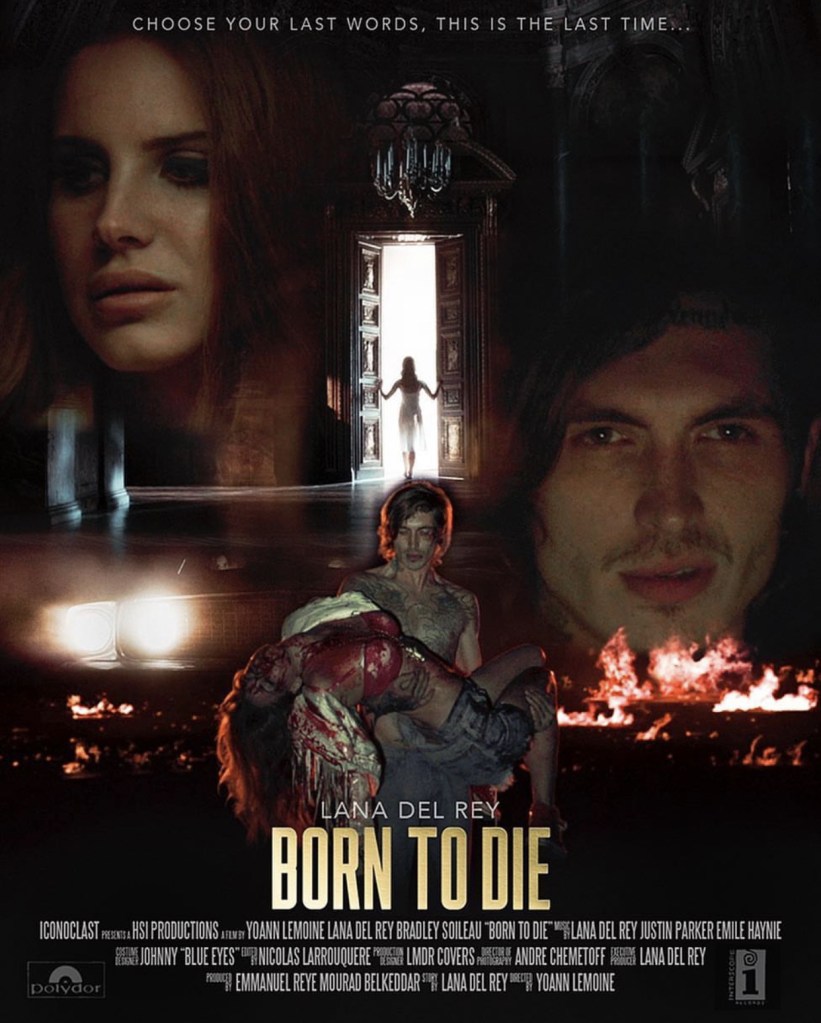
Del Rey dies in a fiery crash at the end of her Born to Die music video. She is seen bloody and beautiful and is adorned in an ethereal white gown in a highly decorated church. She sings about the inevitability of death surrounded by religious imagery. In one scene she lies on a bed surrounded by flowers, almost like the flowers seen around a coffin in a chapel of rest. There is no denying that the video is impressive – with many comments on the page stating how much they relate to the music that Del Rey produces. Death doesn’t seem to be a divider here. Fans don’t seem to feel she is romanticising dying young but is singing about her own contemplations on mortality. In the comment section of one of her videos in fact, a fan states they listen to Del Rey when they have suicidal thoughts to see how beautiful the world can be, and that they feel comfort in knowing someone else feels how they feel. The video in question is Ride, where Del Rey states ‘Live fast. Die young’ as part of the video monologue. But is this literal?    

Born to Die music video (Source: IMDb)

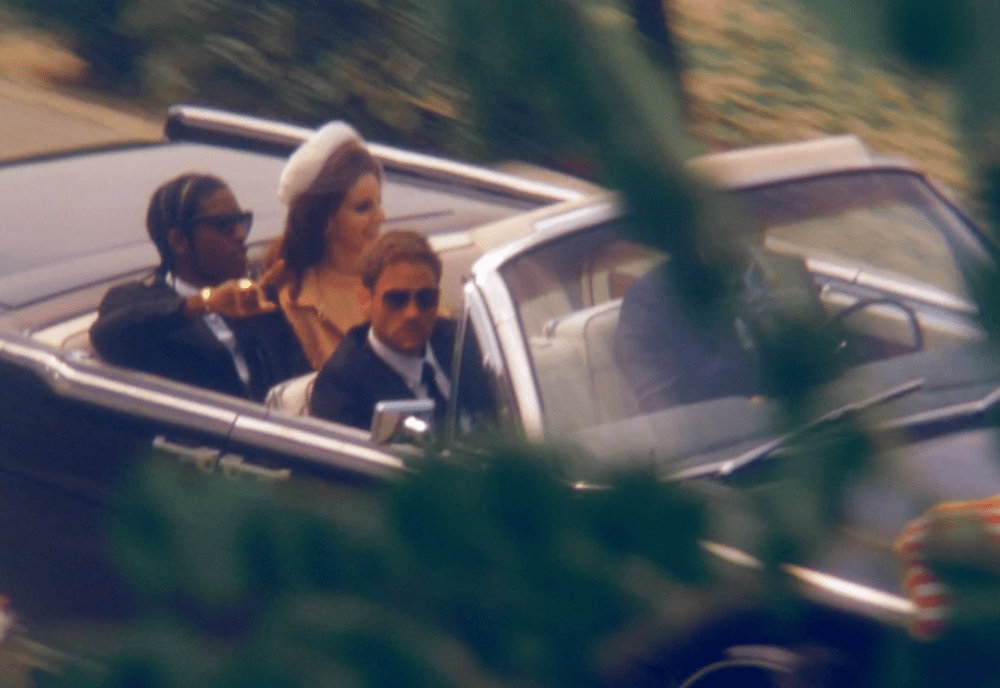
Del Rey also uses imagery and writes lyrics associated with celebrities who died young, including Marilyn Monroe, Jim Morrison, Elvis, and JFK. National Anthem shows Del Rey playing both Marilyn and Jackie O, almost as if she is playing the role of Marilyn if she had become JFK’s wife. At the end of the video, we see the recreated assassination of JFK with a distraught Del Rey in the back seat of the car. Americana imagery is rampant, something she stepped away from a bit with the growing turmoil of American politics in recent years.

The JFK assassination is recreated in the Nation Anthem music video (Source: Genius.com)

27 Club

Frances Bean Cobain criticised Del Rey for romanticising the death of young musicians after the Guardian released an interview with her in which she is reported to have stated, ‘I wish I was dead already.’ In fact, Pop Matters in an article from 2014 stated that, ‘By re-imagining her life as a blown-out Hollywood production about someone who really wants to join the 27 Club, Del Rey acknowledges the world’s fascination with tragic woman and invites them to watch a new train wreck.’ In the same Guardian piece, Del Rey cites Amy Winehouse and Kurt Cobain as two of her heroes (In fact, she even has Amy tattooed on her collarbone) – both of which are members of the infamous 27 Club. Lana later criticised the interview, saying her words were taken out of context and that she mentions her heroes because they are talented, not because they died young.

Suicide or suicide ideation is also mentioned in some of Del Rey’s lyrics. In Dark Paradise she sings, ‘I wish I was dead’. On her Honeymoon albums she sings ‘Dying by the hand of a foreign man happily’ (Salvatore) and on her Lust for Life album one of the demo versions of the songs states ‘She wants to die, lie-la-lie, And she should fucking try, lie-la-lie’ (Beautiful People Beautiful Problems). In fact, the song and music video Lust for Life is thought to reference the 1930s suicide of Peg Entwistle. In 2017, Crack Magazine and Genius discussed the video stating there were a lot of parallels between the video and the famous 1932 death. Entwistle was an English actress who jumped from the ‘H’ of the sign after being cut from a movie.

Del Rey and the Weekend in the Lust for Life video pictured beside Peg Entwistle (Source: veryinutilpeople.it)

On her Norman Fucking Rockwell album, some have interpreted her song ‘How to Disappear’ as a reference to suicide, and on her Blue Bannisters album Del Rey screams ‘I don’t wanna live’ in her song Dealer. On her new album, in the song ‘Fingertips’, some think she may be referring to a suicide attempt in the lines, ‘When I was fifteen, naked, next-door neighbors did a drive-by/Pulled me up by my waist, long hair to the beach side/I wanted to go out like you, swim with the fishes’. Can these lyrics be seen as a glamourisation of death/ suicide, or are they songs written by someone who has these type of thoughts and feelings?

A Funeral Song, Grief, and Loss

Del Rey poses in a hearse for Billboard Magazine 2023 (Source: celebmafia.com)

Del Rey’s new album was released last week entitled Did you know there’s a tunnel under Ocean Boulevard? Death is a theme in this album – but it feels more a move towards grief rather than Del Rey’s contemplation of her own mortality in her earlier albums. ‘The Grants’ (Del Rey was born Lizzy Grant) has been making the rounds of TikTok, with some saying that they want the song played at their funeral. The song mentions heaven and how memories are the only things you bring with you when you die. Del Rey lost her grandmother, the memory of her smile is what she wants to take with her – ‘My grandmother’s last smile/I’m gonna take that too with me.’ Lana also mentions the death of her uncle Dave and Grandparents in ‘Fingertips’, as well as a family mausoleum. ‘Kintsugi’, a beautiful track referring to the Japanese art of repairing pottery cracks using gold, is almost like a love letter to her own grief. Del Rey mentions how she couldn’t be at a death, who will be with you at your death, and laments, ‘Daddy, I miss them.’ ‘Kintsugi’ seems to refer to the cracks that form in the grieving process, and ‘that’s how the light gets in.’ Del Rey has been ‘cracked open’ by grief but it is now something beautiful. This type of imagery is very different to the glamourous, sultry visuals of her early career when she mentions death. Even though this album mentions the death of loved ones, it almost seems more serene.

Death – authentic or aesthetic?

Del Rey seems to be a multi-layered artist, with mortality featured throughout all eras of her career. Even though the way in which it is discussed has changed and developed over time, it has remained a constant in her craft. Even though she has faced criticism for this aspect, one can’t help but notice the consistency which suggests authenticity. Comments on a YouTube video by Mina Lee in 2021 (Lana Del Rey: the pitfalls of having a persona) suggest fans don’t find her mentions of death as a fashion statement, but rather that she was a rejection of being perfect and a way to champion expressing one’s emotions. Many also stated that as a female celebrity, she shouldn’t be pressured into being a good role model. Perhaps Del Rey’s mentions of death and dying allowed for many to move their interest into the ‘death positive’ movement – something I found her music pushed me towards.

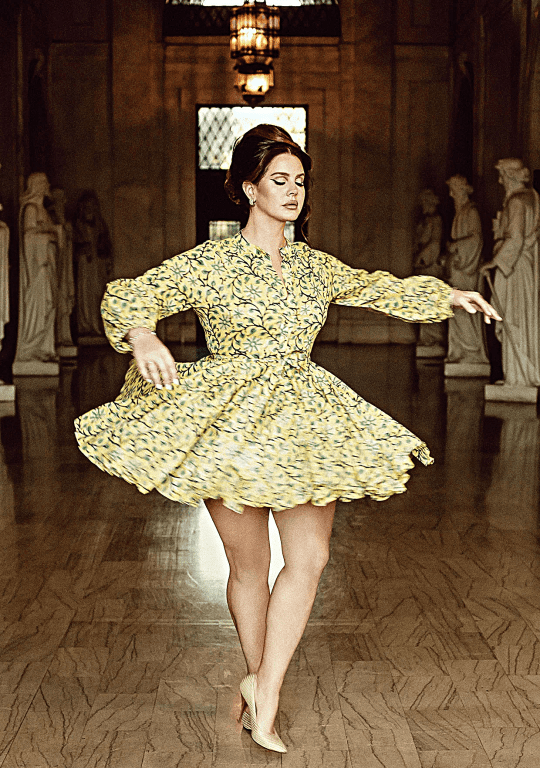
Del Rey pictured at the Hollywood Forever Cemetery for Billboard Magazine in 2023 (Source: femalestunning.tumblr.com)

Sources

https://genius.com/a/how-lana-del-rey-s-lust-for-life-connects-to-an-infamous-hollywood-suicide

https://www.dazeddigital.com/photography/article/28463/1/girls-are-finding-empowerment-through-internet-sadness

https://www.popmatters.com/183202-a-tragedy-wanting-to-happen-death-and-lana-del-rey-2495645993.html

https://www.buzzfeednews.com/article/izzyampil/lana-del-rey-album-review-did-you-know-that-theres-a-tunnel

Lana Del Rey Reveals: ‘I Wish I Was Dead Already’

https://www.theguardian.com/music/2014/jun/12/lana-del-rey-ultraviolence-album

https://lanadelrey.fandom.com/wiki/Lana_Del_Rey_wiki

Images:

https://www.fanpop.com/clubs/lana-del-rey/images/29201930/title/born-die-music-video-screencap

https://genius.com/Lana-del-rey-jfk-lyrics

https://www.imdb.com/title/tt7078332/

https://celebmafia.com/lana-del-rey-billboard-magazine-02-25-2023-issue-3562217/

An archaeologist visits Bodyworlds

Recently, I was lucky enough to have an opportunity to visit the incredible Bodyworlds exhibit in Amsterdam, The Netherlands. I have seen and handled plastinated specimens before in a university department, but I had not seen them on display in a museum context. In this blog post, I will discuss some of the thoughts I had as an archaeologist concerned with the ethics of human remains display, and how these modern-day collections echo some of the sentiment applied to collections of the past. The technology involved in creating these plastinates is simply amazing, and if you have any interest in human anatomy I would highly recommend visiting the exhibit.


The Bodyworlds exhibit: Where and what?

The exhibit I visited featured 200 plastinated human specimens on public display. This particular exhibit was entitled The Happiness Project. The exhibit had over 200 plastinates on display – if you want to read more about the process of plastination then you can do so here. Plastination involves preserving real human bodies using a process that removes water and fat. These are replaced with plastics, making the specimen dry and stopping the decaying process. Von Hagens invented the process and has exhibited the Bodyworlds plastinates to millions all over the world. The Happiness project used the plastinates to show how our happiness is impacted, and how our health is related to our mood. One of the infographics outlined the sources of happiness in one’s life – suggested that 50% was genetics, 40% was what we could control, and 10% was sources outside our control.


Gender assignment without consent
There was a group of four of us that attended the exhibit. On one of the levels we entered we were greeted by a large screen that we could not avoid. The screen assigned us a gender and an age category automatically. I couldn’t help but recognise how uncomfortable this may have made some people, especially those who may be struggling with their gender identity, or who identify as non-binary. You are assigned male or female, with some people at the exhibit being mis gendered by the screen. Also, many people were pointing out they were also given a different age bracket – most were being given an older age then they actually were. Not great in a society that dwells heavily on anti-aging. I could see that some visitors were a bit uncomfortable with this element of the exhibit, and I couldn’t understand why this element was incorporated. The screen reading itself was showing how ‘happy’ the viewer was by reading their face – but I think the gender/ age element was unnecessary. The body and identity – particularly gender identity – is a topic under discussion in both archaeological and contemporary contexts. Control of one’s narrative is important and having one’s identity ‘up on screen’ without their input is quite intense.


The identifiable nature of the human head
One of the human heads on display still maintained their facial features, it did not look like the classic image of a plastinate – the ones which look unidentifiable with the muscles depicted. This head still has hair and the outer layer of skin attached. The face was quite identifiable – if a family member had seen it they would definitely have recognised them. Obviously, the donor in this case gave their body to be plastinated – fully consenting. However, I still wonder if the donor and their loved one realised this would have been the case if they were viewing the more ‘classic’ plastinates. Although the head was anonymised – meaning they were not named etc. – it still was a jarring sight. Nevertheless, the head is an amazing feat of preservation technology which shows the realistic element of a cadaver – a stark contrast to skeletal remains and historical fluid preserved specimens on display in museums. The ‘flesh on the bones’ really humanises the plastinate, I could even see moles and other spots on the skin.

The sex plastinate
If you have read about the Bodyworlds exhibit, you have probably heard about the sex plastinate that caused controversy some time back. The controversial plastinate in question showed two cadavers preserved in the reverse cowgirl position. With articles with headlines such as ‘You Can See Dead People Having Sex for Less Than $20’ appearing on the internet it’s clear the pose certainly ruffled some feathers. The Happiness project also has a sex plastinate on display, which showed two cadavers in a much less provocative pose, but still showing sexual intercourse regardless. I thought this display was presented fantastically – It wasn’t shocking, but was presented beautifully, somewhat unexpected in a city often associated with sex. And why shouldn’t sex be presented? It is, after all, a huge element of life. Sex and death have strong links in many ways – both are taboo but also get people interested and talking. In fact, I thought another plastinate perched on a swing with their legs opened slightly was a little more provocative to the viewer.


Art versus human remains
Overall, I highly recommend the Happiness Project if you are visiting Amsterdam. The technology involved in plastination is incredible and these donated bodies are presented fantastically – skilfully linking art and science. Not often are the general public able to view anatomical specimens, and Bodyworlds gives the layperson that opportunity through exploration of wellbeing. As an archaeologist visiting the exhibit I couldn’t help but compare these remains with archaeological and historical displayed specimens – and I kept having to tell myself that these people consented. No matter how different these displays are to other museums displays – one has to remember plastination is voluntary, unlike excavated and historically preserved remains in many cases. On that point alone, Bodyworlds is commendable.

The post-mortem fate of Elvis Presley: Another case study in bodily integrity

A while ago I did a blog post on the post-mortem fate of Marilyn Monroe, which has generated a lot of interest on my blog. Celebrities – dead or alive – have a power over us. Decades after their death they still pique our interest. Marilyn has become a hot topic once again recently in the news, with Kim Kardashian damaging her dress at the Met Gala, the release of a new Netflix documentary about her death, and with a new movie about her called Blonde set to be released soon. There has been some outcry online to ‘let her rest’ and to stop speculating in aspects of her life and death. I doubt very much that this will be the case. In fact, those posting about letting Marilyn rest are doing the exact opposite of what they are preaching. She is clickbait for many, which brings up many aspects of post-mortem bodily integrity. With the recent release of Baz Luhrmann’s new Elvis movie, I thought looking at the post-mortem bodily integrity of Elvis Presley was important. Like Marilyn, Elvis is considered one of the greatest icons of the 20th century. So how was Elvis’s body treated upon his death? First, a little bit about ‘The King’.


Who was Elvis Presley?
Elvis Aron Presley was born in Mississippi in 1935. He began his rock and roll career in 1954 in Memphis Tennessee. Despite the flamboyant costumes and the lavish surroundings Elvis became known for, he started off very poor. His musical style was inspired by blues, country, and gospel. Throughout the 1950’s his rockabilly style dominated the charts for the first time – paving the way for other rock musicians. Presley, with his slicked back black hair and thrusting dance moves, became a sex symbol. His good looks and talent meant he also became a movie star and appeared on numerous television specials. His career continued to be successful into the 1960’s, and in 1967 he married his long-time girlfriend, Pricilla. Shortly after, they had a baby girl called Lisa Marie. The two eventually divorced in 1973 but remained good friends. In the 70’s he continued to tour but his lifestyle was catching up with him. He took prescription drugs, ate fatty foods, and had a terrible sleeping pattern – it was even reported he reached 350 pounds in weight. Even at the height of his career he always lacked confidence in himself and feared slipping back into the poverty he experienced in childhood.


How did Elvis Presley die?
Elvis was found dead at his home in Graceland in 1977 at 42 years old. Like most significant cultural icons from the 20th century, his death has been met with speculation and controversy. There have been derogatory jibes made about the position he was found in (i.e., the King died on the Throne) – he was found in the bathroom, likely having died on the toilet before falling to the ground. The fact he was found with his pants down in such a vulnerable position, questions how much information should be released to the public. Is letting the public know he died on the toilet a violation or post – mortem humiliation? Ginger Alden wrote in her memoir about the position in which she found her then boyfriend, as well as how he physically looked upon his death.
Elvis was known to have had a horrific drug problem in the years leading up to his death. He also was reported to have needed a full-time nurse to help him in the months leading up to his death, and that his awful diet even consisted of cheeseburger platters. I recently read Mary Roach’s excellent book Gulp in which she talks about Elvis and his diagnosis of megacolon. He had suffered from chronic constipation due to his diet, colon condition and drug use – it is thought he died from a heart attack brought on by Valsalva manoeuvre. It has also been suggested that he died from a drug overdose that caused his heart to stop. There has also been a theory that he died from a heart attack brought on by an autoimmune condition caused by a brain injury from a fall in 1967. Whatever the case, it is clear his heart stopped very quickly.

What happened to Elvis’s body? Elvis was brought for an autopsy to establish a cause of death at Baptist Memorial Hospital – however, the results of the autopsy have been sealed from the public record until 2027 (50 years after his death). Elvis was embalmed after he was brought to Memphis Funeral Home – he was dressed in one of his famous suits and his hair/ sideburns were dyed to hide his greying hair. He was then transported to Graceland for a public viewing under the direction of his father, Vernon Presley. Vernon was also the person who ordered the results of his autopsy to be sealed, causing much public speculation and even rumours about Presley faking his death. The death of such a well – known celebrity has often come with rumours of the death being a hoax. It’s a question of whether these rumours are generated from the public in denial of the death, from ‘genuine sightings’, or from those who wish to keep their memory alive. There were rumours that the body on display at Graceland was actually a wax dummy that appeared to have ‘beads of sweat’ from melting slightly. His dead body was scrutinised by thousands of people, even though the opened end of the casket was placed slightly out of sight of fans.

Over 30,000 fans were let into the foyer of Graceland to view the open casket before a scaled back funeral service was held at the estate. There were reports that some of fans fainted upon seeing the casket. Friends and Co-stars of Presley were present at the small ceremony before 80,000 fans followed the funeral procession to the burial at Forest Hill Cemetery. He was buried next to his mother, Gladys. A BBC presenter discussed the interaction he had with the family upon viewing the body of the star. Michael Cole was one of the first to view the body and in a Daily Mail article he commented that the head (of a deceased Elvis) was the size of a ‘watermelon’ and he was ‘deathly pale’. He goes on to say he speculated the bloating of the body was from drug use and that the hairstyle that had been done by the hairdresser at the funeral home ‘upset’ him. Like Marilyn, we see that even in death, the appearance of public figures is (and was) commented on. Even the dead are not ‘off limits’ and expected to look their best.

Unfortunately, there was an attempt made to steal the remains of Presley and his mother in the same year as his death. Nine days after the burial, Raymond Green, Eugene Nelson, and Ronnie Adkins attempted to steal the corpse with the intention of holding it for ransom. It was reported they had explosives with them to blow open the mausoleum, and the heavy, copper casket. The casket had been so heavy in fact that eight pallbearers were needed. There has been accusations made against the Presley family themselves, suggesting they were part of the plot to indicate that Elvis should be buried elsewhere – i.e., at Graceland. Initially, burial of Elvis at Graceland was not permitted by the Memphis board. If the body was elsewhere and required security, then surely it would make sense for him to be buried at Graceland where it could be safe? Specifically, his father Vernon – the same man who allowed for public viewing of the casket – has been most associated with the plot. Even more disturbingly, it was suggested that Vernon wanted his son moved to Graceland to generate more income from fans and tourists visiting the estate. If that is true, then even the remains of the King were being seen as something to generate wealth. Some speculate that none of the Presley family are actually buried at Graceland and that their bodies are elsewhere for family members to visit them privately.

In 2010 the Chicago Tribune reported that the embalming tools used on Elvis were being put up for auction by the embalmer who looked after his body. One cannot deny how much of a violation of trust this is. Those working in the death care industry have a responsibility to respect the dead and their families. The ‘John Doe’ tag, rubber gloves, forceps, lip brushes, a comb and eyeliner, needle injectors and aneurysm hooks all allegedly used at the funeral home were up for auction. The lot was eventually withdrawn, not because it was disrespectful to the memory of Presley, but because the authenticity of the tools was brought into question.

Elvis can be considered one of the greatest icons of the 20th century, and continues to generate wealth, conversation and an extraordinary fanbase. It is sad to think that one of the greatest musicians and sex symbols of the 20th century met such an untimely end. His headstone now reads ‘Elvis Aaron Presley’ – Aron is spelled incorrectly, a heart-breaking realisation when you understand that one of his greatest fears was to be forgotten.  

Sources

Roach, M., 2013. Gulp: Adventures on the alimentary canal. WW Norton & Company.

https://www.liveabout.com/details-of-elvis-presleys-funeral-2522426#:~:text=Elvis%20was%20embalmed%20at%20the,30%2C000%20fans%20were%20let%20in

http://www.autopsyfiles.org/reports/Celebs/presley,%20elvis_report.pdf#

https://www.cheatsheet.com/entertainment/elvis-presleys-corpse-was-almost-stolen-and-held-hostage-by-grave-robbers.html/

https://www.express.co.uk/entertainment/music/1325304/Elvis-funeral-death-coffin-where-is-Elvis-buried-fans-Graceland-Vernon

https://www.chicagotribune.com/news/ct-xpm-2010-07-21-ct-talk-elvis-autopsy-auction-0722-20100721-story.html

https://www.express.co.uk/entertainment/music/1226950/Elvis-Presley-death-died-of-heart-attack-father-Vernon-funeral-grave-fans-music-date-age

https://www.independent.ie/entertainment/music/elvis-autopsy-tools-withdrawn-26665559.html

https://www.academia.edu/4603315/Did_Elvis_Fake_His_Death

https://www.mirror.co.uk/3am/celebrity-news/elvis-presley-constipated-4-months-23395093

https://www.dailymail.co.uk/news/article-6060861/BBC-reporter-Elvis-Presley-dead-coffin-admits-new-truths.html

https://en.wikipedia.org/wiki/Elvis_Presley

The Death of Anne Lister: Her Post-Mortem Fate

Anne Lister – her life and diaries have gained fame in recent years, especially since the release of the hit tv show Gentlemen Jack starring Suranne Jones. Anne was born in 1791 and began writing her diaries at the age of 15. She was a businesswoman and ran her family estate – Shibden Hall- in Halifax, West Yorkshire. Anne dressed head to toe in black (a woman after my own heart), was an extremely independent woman, and had numerous lesbian affairs. She is often called the ‘first modern lesbian’ and thought of her life partner, Ann Walker, as her wife. The two took sacrament together is a ‘wedding ceremony’ at Holy Trinity Church in York. A plaque dedicated to their union was unveiled there in 2018.  Anne’s’ life was chronicled so much in her diaries, but what about her death? How and where did Anne die? Where is she buried now?

Horner, Joshua; Anne Lister of Shibden Hall (1791-1840); Calderdale Metropolitan Borough Council; http://www.artuk.org/artworks/anne-lister-of-shibden-hall-17911840-21162

Anne was an avid traveller, has produced volumes upon volumes of travel writing. In 1840 she travelled to Georgia as part of a prolonger trip with her partner Ann Walker. The two had begun the trip in 1839, and had travelled to Scandinavia, the Netherlands, Belgium, and Russia before reaching Georgia. Anne recorded a nasty insect bite she obtained in Georgia in August of 1840. A virulent fever prolonged her death, she suffered for six weeks before dying in the September – she was only 49 years old. It is reported that it took Ann Walker over six months to bring her body home. Her death was reported in the Halifax Guardian on Halloween, reporting that:

We are informed that the remains of this distinguished lady have been embalmed.

Anne’s body is believed to have been brought to Moscow for embalming. Ann Walker ensured her remains were to be transported back to England via Turkey by sea. There has been some suggestion that Anne’s remains would not have been embalmed as the arterial technique was not widespread at the time. However, it may be the case that Anne was partially embalming in some manner that may not have been arterial. Apothecary embalming practices pre-date arterial embalming and may have been used in some manner in the preservation of Anne. Viscera may have been removed and herbs/ alcohol may have been used. Embalming in the 18th century was often thought to be reserved for the likes of royalty, but Anne was a wealthy woman of noble birth who was to be repatriated in the 19th century, meaning her death was not a normal circumstance. Although Jean Gannal did not develop arterial embalming fully until 1841 – arterial system preservation was being practiced in anatomical specimen preservation. John Hunter was quite a prolific ‘preparer’ of specimens in Britain during the 18th century, and William Harvey’s work on the circulatory system had been published in the 17th century. Anne’s body was reportedly brought to Moscow for preservation, it is not inconceivable that scientific endeavours in the city allowed for her to be embalmed to some extent.

The font at Halifax Minster where Anne was baptised

As well as being preserved, Anne was also placed in a lead lined coffin or lead shell which was then placed inside another wooden coffin. It was lawfully required for a prolonged period in the 19th century for coffins to be lead-lined to allow for leakage prevention. Her body finally reached Shibden Hall in Halifax in April 1841 – over 6 months after her death. Her funeral was reported to have been attended by thousands of people, with crowds gathered in the streets. The funeral procession consisted of typical Victorian funeral traditions, including a hearse, coaches, and carriages. Anne is one of many Listers to be buried at the minster, but she is by far the most famous. Her exact burial place is not known as her tombstone was broken and moved in the 1870’s (many assume she is buried in the family vault which is located somewhere in the church). It was not found again until 2000 and is now on display at the minster. Listers tombstone still has flower offerings laid on it today, and there are calls from many, including Sally Wainwright, creator of Gentlemen Jack the tv show, for her exact resting place to be located. Over 150 years after her death, the location of Anne’s body is still in the minds of many who are inspired by her and her resilience. Even in death, Anne Lister still interests and captivates people.

Anne Lister’s Tombstone at Halifax Minster

Sources

https://museums.calderdale.gov.uk/famous-figures/anne-lister

https://en.wikipedia.org/wiki/Anne_Lister#:~:text=Lister%20died%20on%2022%20September,Minster%2C%20on%2029%20April%201841.

https://www.historyextra.com/period/victorian/anne-lister-real-gentleman-jack-diary-code-history-secret-life-britain-first-modern-lesbian/

https://northernlifemagazine.co.uk/the-mystery-of-gentleman-jacks-tombstone

https://www.yorkshirepost.co.uk/heritage-and-retro/heritage/gentleman-jack-creator-sally-wainwrights-call-for-anne-listers-burial-spot-to-be-found-3642920

https://www.packedwithpotential.org/stories-articles-writeups/where-is-anne-lister-halifax-minster/where-is-anne-lister-halifax-minster-v3

Damon, A.B., 2020. Anne Lister,“A Sundial in the Shade”: A Gifted Woman in the Nineteenth Century. Women’s Studies49(2), pp.130-148.

Zigarovich, J., 2009. Preserved Remains: Embalming Practices in Eighteenth-Century England. Eighteenth-Century Life33(3), pp.65-104.

https://artuk.org/discover/stories/lesbian-love-and-coded-diaries-the-remarkable-story-of-anne-lister

When Lightning Strikes: The Tragic Story of the ‘Romeo and Juliet’ Grave

A close friend of mine recently told me about a tragic burial at St Thomas’ Church in Leeds. The church has been a place of worship in Stanningley since the 1840’s. Heavily Methodist influenced, the church has two side aisles rather than one central aisle. The church also is home to some beautiful Victorian stained-glass window. One of these windows has been crafted in memory of a young couple who died in the area in 1869. Their grave is located in the churchyard, which my friend’s dad refers to as the ‘Romeo and Juliet’ grave – Patrick Simpson lays flowers every year in memory of these two young Sunday school teachers. A poignant reminder of this tragic story – the subject of my blog post this month.

Emma Carrick and Thomas Hardaker were aged between 20-22 when they were killed in September 1869 during a violent storm. They had been courting for 2 or 3 years and were the children of basket makers and cloth weavers from the Pudsey and Stanningley areas. According to a lengthy news article that reported their deaths, the couple were keen to spend much time together the weekend of the tragedy, as Thomas was travelling a lot with his brother to take charge of a bazaar. The couple were last seen together in conversation by locals before their bodies were discovered after they were ‘struck down by the electric fluid and killed on the spot.’ It was thought they were both struck by the lightening as they had been in close proximity to an iron railing. They were both found lying next to each other with scorch marks upon their faces – the only indication on their bodies that they had been struck. The coins found in Thomas’ possession were found to have melted together from the strike.

The funeral of the lovers attracted a huge crowd, with both hearses travelling in procession side by side. It was estimated that up to 7000 people attended the ceremony. Factory workers attended in their work clothing, with the friends and family of Thomas accompanying his side of the hearse and Emma’s accompanying hers. Mourners were seen adorned in the traditional Victorian black garb and also in some white garments – likely representing the youth and innocence of the couple who were due to be married in two months before their death. Black cloth was placed upon the coffins and the Death March was played as the coffins were being interred – first Thomas, before Emma was placed on top. Understandably, their death was spoken about all over the North of England. The newspaper report from Leeds at the time emphasised the fact that both of them looked peaceful in death, and that it did not seem that they had suffered in their demise. The rosiness of Emma’s cheeks in death was especially emphasised. It was also written that perhaps the couple deemed so respected and worthy that they were deemed fit to pass painlessly by God due to the tenderness of their love – the newspaper stated that the Romans thought anyone struck by lightning were favourites of the gods. Although the write up of their death is poetic, no amount of flowery language can hide the fact that these young lovers suffered a tragic fate.

Image courtesy of Gemma Simpson

You can visit the gravestone today. On the gravestone it states that Emma and Thomas were –

‘Entr’d into rest Sept 5th 1869

Being Called Home By A Flash Of Lightning.’

The inscription also states how well liked the both of them were, and that they were both teachers in the Sunday school. I think the ‘Romeo and Juliet Grave’ is a fitting name for them – both couples having died in tragic circumstances.

Sources

http://www.calverley.info/

http://www.calverley.info/lt1.htm

Death on Display: The Dead in the National Museum of Ireland: Archaeology

Five Examples of the Displayed Dead

In March 2022, I visited the National Museum of Ireland on Kildare Street, Dublin. This archaeology museum is free to the public and is well worth a visit if you are ever in Dublin. The human remains are displayed very well in the museum, being securely laid out behind glass and lit very well. The bog bodies exhibit in particular is laid out excellently. I remember visiting this museum as part of my undergraduate modules when I was studying at UCD. Here are five examples of how the dead are displayed in the museum.

Clonycavan Man, Co Meath.

Date: c. 392-201 BC

The bog bodies on display in the museum are perhaps the most evocative of the dead featured. The display of the bog bodies is done in a respectful manner, with visitors able to bypass viewing the remains if they wish. Clonycavan Man is featured in the Kinship and Sacrifice Exhibit, which also features the other Irish bog bodies. Clonycavan Man was found in 2003 and is believed to be a murder victim, with possible indications that he was mutilated as part of a ritual killing (his nipples are missing for example). He also seems to have suffered a deep head wound that may have been the cause of his death. A reconstruction of the face of Clonycavan Man further humanises him – a ‘face put to the name’, as well as the discussion surrounding his ‘gel’ hairstyle which consists of resin. The hair and skin of Clonycavan Man is visible, although they have changed to a brown colour due to the anaerobic conditions of the bog, but his features are still very visible regardless. I highly recommend visiting this exhibit if you are ever in Dublin – they are a fantastic resource to engage in conversations about death and the display of the human body.

Replica of Clonycavan man
Clonycavan man

Viking Burial, Memorial Park, Co Dublin.

Date: c. 9th Century

An almost fully intact skeleton is on display in the Viking Ireland section of the museum. The skeleton dates to the 9th Century as was found in 1934 at Memorial Park, Island bridge, Dublin. The burial is labelled as belonging to a warrior, as a dagger and sword were found with the skeleton. Unfortunately, there does not seem to be much other information accompanying the burial, which may have been due to a lack of information being gathered and recorded at the time of discovery. Furthermore, members of the public are not told whether the burial is male or female, something not known to the untrained eye – it is simply implied by the ‘warrior burial’ label. The ‘warrior burial’ label was also critiqued by Howard Williams on his blog (link in sources section).  The skeleton is dimly lit with partial reconstruction done on some elements of the skeleton. The glass case makes sure the remains are secure and cannot be touched by members of the public, and the darkness of the exhibit does allow one to appreciate the fact human remains are on display. Should these skeletal remains be presented in the same manner as the bog bodies? I.e., in a small, labelled section away from public view? These are the questions one should ask as a viewer – how much of human remains is too much for the public?

Viking burial

Burial 24, Mound of the Hostages, Hill of Tara, Co Meath.

Date: c. 2000 BC

Burial 24 contained an inverted encrusted urn and an inverted vase – the urn contained the remains of at least one adult, and a burnt flint knife was also found with the remains. As there is work going on in the museum at the moment, the entrance is now through the Hill of Tara section where this burial is located. You almost pass it by as you enter the museum. The exhibit shows fantastic finds through the centuries at the Hill of Tara. What is interesting about the cremated remains is that one would likely not realise you were viewing human remains unless you read the label on the exhibit. Do people pass by these remains without realising they are passing a part of someone? It would be interesting to do observations of visitor interactions with all the exhibits containing human remains and see how different ‘types’ are reacted to.

Cremated remains seen in the centre

Human Skull, John’s Lane, Co Dublin.

Date: c. 10th Century

As part of the Clontarf 1014: Brian Boru and the Battle for Dublin exhibit at the museum, I will be focusing on the human skull found at John’s Lane, Dublin. The skull itself is place in a glass case with an accompanying label stating the skull is from a young man, and that a large wound to the side of his head may have been fatal. What is unsettling about the skull, is the fact it is placed as though found with a ‘slave chain’ that was recovered from a completely different context. It gives the impression that this individual was from the slave trade, despite not being found with the chains – I remember mentioned the issues with this display as a case study as part of my undergraduate visit. It may be that the placement of the chain is to provoke a reaction from the viewer. The chain was found in Roscommon and may have been made for a slave or hostage.  Although the placement is obviously to illustrate what it would have been like for someone to wear such a device, it does make one feel slightly uncomfortable knowing the man displayed with the chain was not a wearer in life. A question of identity and post-mortem bodily integrity comes to mind.

The skull and chain display

Ptolemaic Mummy, Provenance unknown (Egypt).

Date: c. 300 BC

There is a large number of objects from Ancient Egypt at the museum, with the Egyptian collection found in the upper galleries. Most of the items on display were acquired from excavations carried out between the 1890s and 1920s. There are a few mummies on display, but for this blog post I will focus on the Ptolemaic Mummy of unknown provenance which dates to c. 300 BC. Unlike the Leeds City Museum, there is no sign outside the exhibit warning people that human remains are on display. This may be because unlike the mummies in Dublin, the Leeds mummy is unwrapped (He was unwrapped by the surgeon TP Teale in the 1820’s), and his facial features are on display and very prominent to the viewer. The mummies in Dublin are still wrapped – providing a ‘layer’ between them and the viewer. The unknown provenance of the mummy is likely due to the retention of the remains outside of Egypt from a dig over 100 years ago – post excavation records were likely not as detailed, particularly during a time when colonial attitudes were rife. The mummy in question is displayed very well with as much information as possible attached to the exhibit – they are also well lit in an area that has dimmed overhead lighting. A great way to show respects but also highlight to artefacts of importance.

One of the mummies on display

Sources

https://100objects.ie/slave-chain/

https://news.leeds.gov.uk/news/leeds-museums-and-galleries-object-of-the-week-coffin-of-nesyamun

https://www.museum.ie/en-IE/Museums/Archaeology/Exhibitions/Kingship-and-Sacrifice

https://www.museum.ie/en-IE/Museums/Archaeology/Exhibitions/Rites-of-Passage-at-Tara